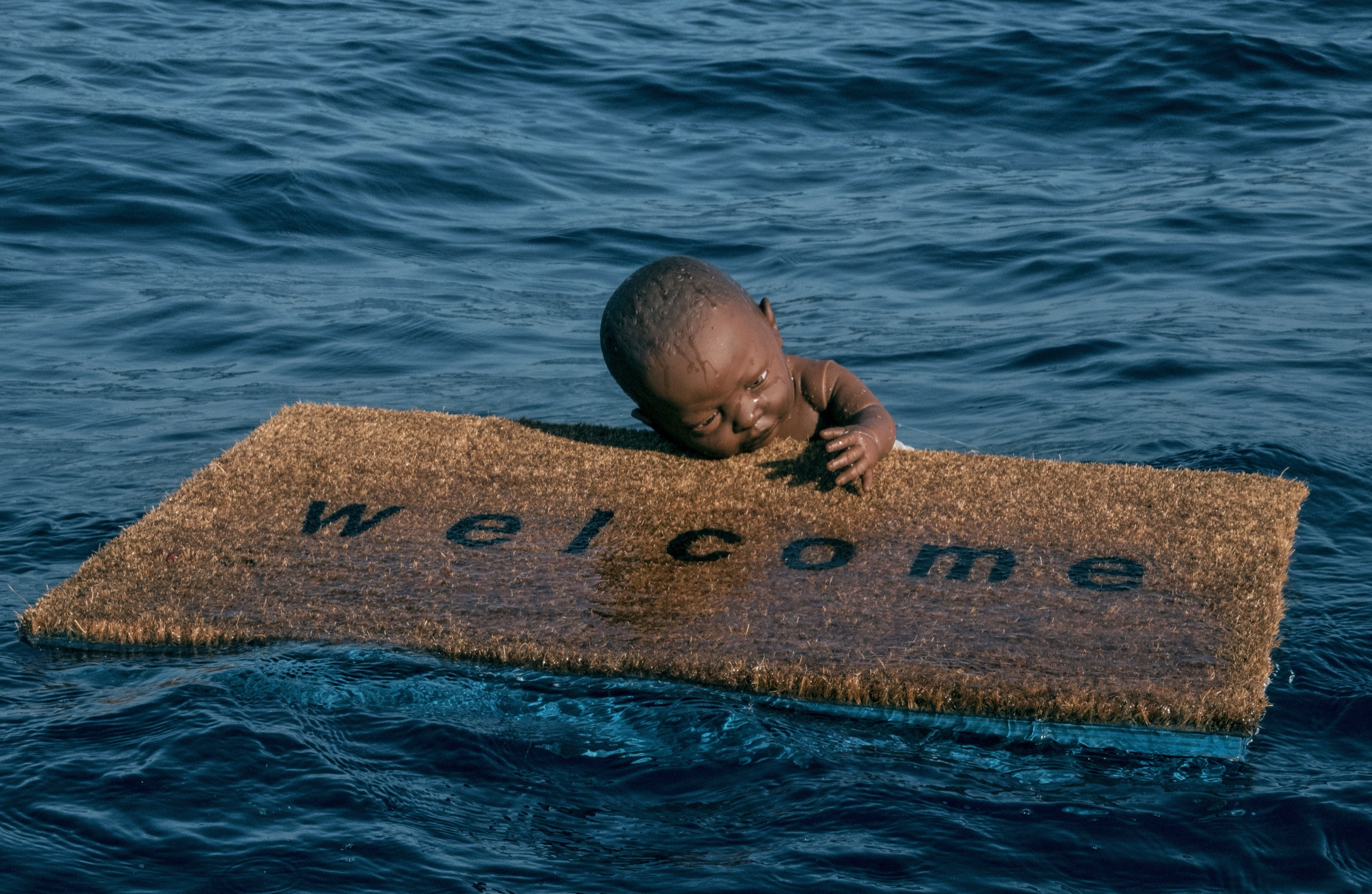
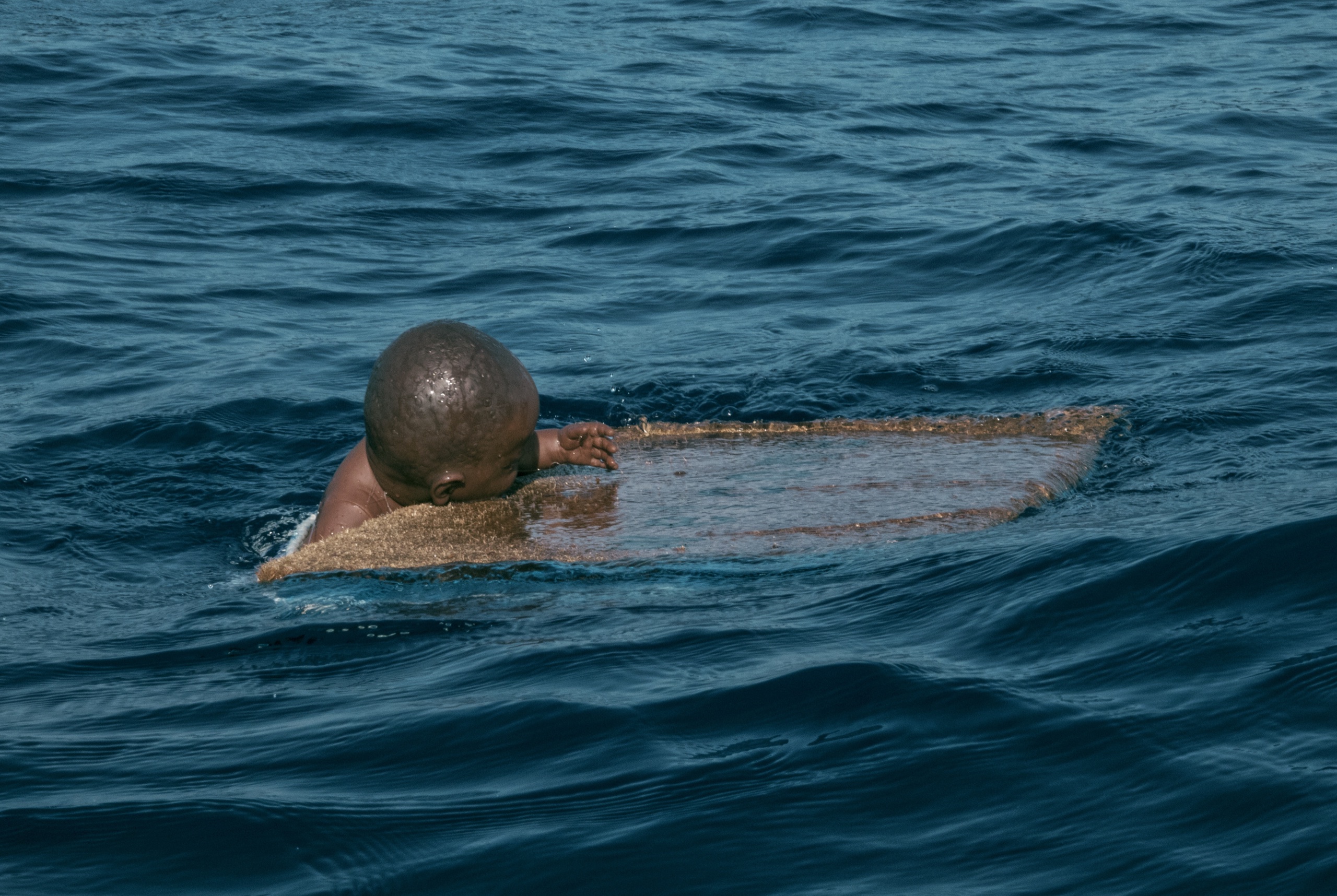
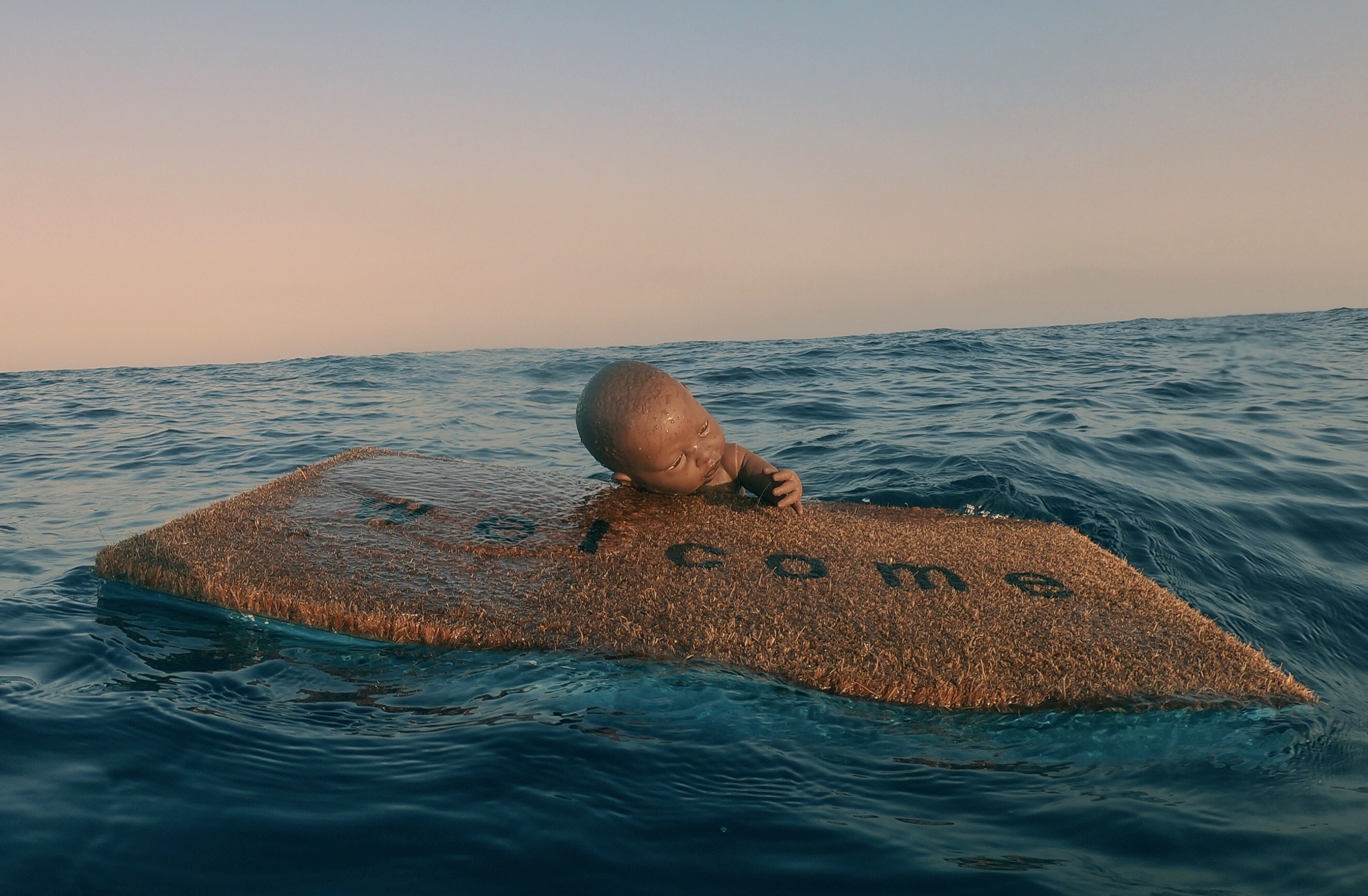
A doormat made of coconut fibre, the most domestic of thresholds, is set adrift on open water and turned into a raft. Clinging to its edge is the figure of an infant in dark-toned plastic, cheek pressed against the bristles, one small hand gripping the rim. The lowercase letters of the word printed on the mat run across the frame like a caption, and the photographs show them half submerged as the swell washes over the coir. The sculpture works through displacement: an object designed to sit flat before a front door becomes a fragile vessel, and the scale of the child, close to life size, keeps the image from reading as allegory alone. Rubber, plastic and natural fibre meet the sea, and the sea slowly erases the greeting.
Few words are as ritual as the one a household lays at its entrance. It costs nothing to print and promises hospitality to whoever crosses the threshold. Placed under a child alone in the middle of the sea, that promise is exposed as conditional: the welcome belongs to those who already stand on solid ground. The sculpture touches the way wealthy societies speak of openness while the crossing itself is left to the most vulnerable, and it does so with an everyday consumer object rather than a symbol of state or border. The infant has no adult beside him, no boat, no luggage. What keeps him afloat is a piece of domestic décor, as if the gap between private comfort and public tragedy were the width of a doormat.
The child does not cry or call out. His head rests sideways on the mat, eyes lowered, in the posture of a toddler falling asleep against a parent's shoulder. That softness is what makes the image so hard to hold: attachment behaviour, the instinct to cling to something warm and stable, is directed at a rough, sodden object that cannot hold him back. A viewer is placed in the position of the one who would normally answer that gesture, and the absence of any adult in the frame turns the onlooker into the missing caregiver. The impulse to reach out meets the distance of the photograph. What remains is a quiet guilt, and the uncomfortable recognition of how easily the word written on the mat can be read without being meant.
A baby, a doormat, the open sea. Federico Clapis needs nothing more to compress a decade of headlines into a single frame. The mat is the ordinary kind sold in any hardware store, coconut fibre with the word welcome stencilled in black, and it floats like a makeshift raft while a small dark figure hangs on with one hand, head tilted, almost resting. In one photograph the light is golden and the horizon calm; in another the water has already covered half the letters. The sculpture lands squarely in the debate over who is received and who is left to drift, and it refuses both slogans and statistics. It simply puts the most familiar greeting in the West where it is hardest to keep.