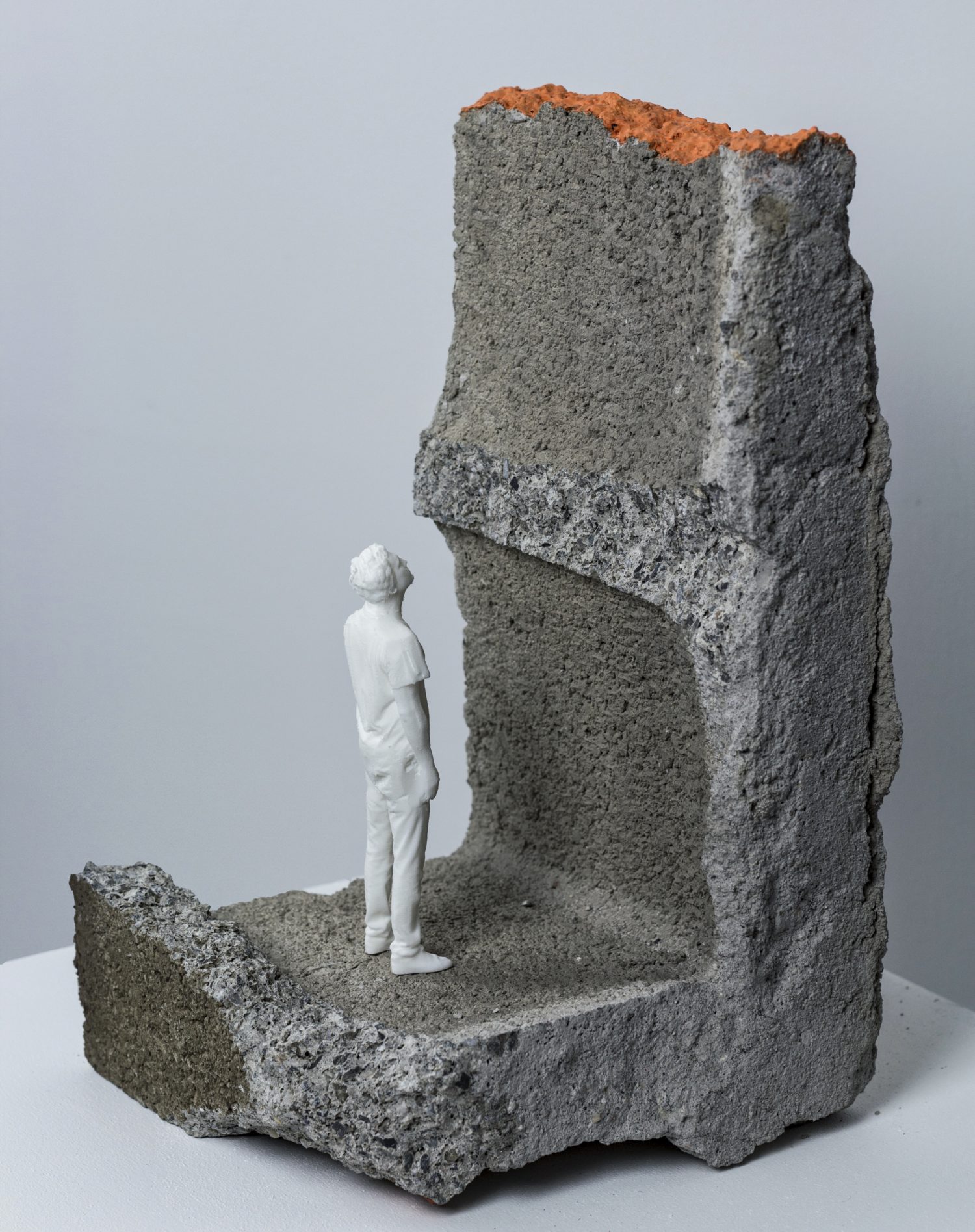
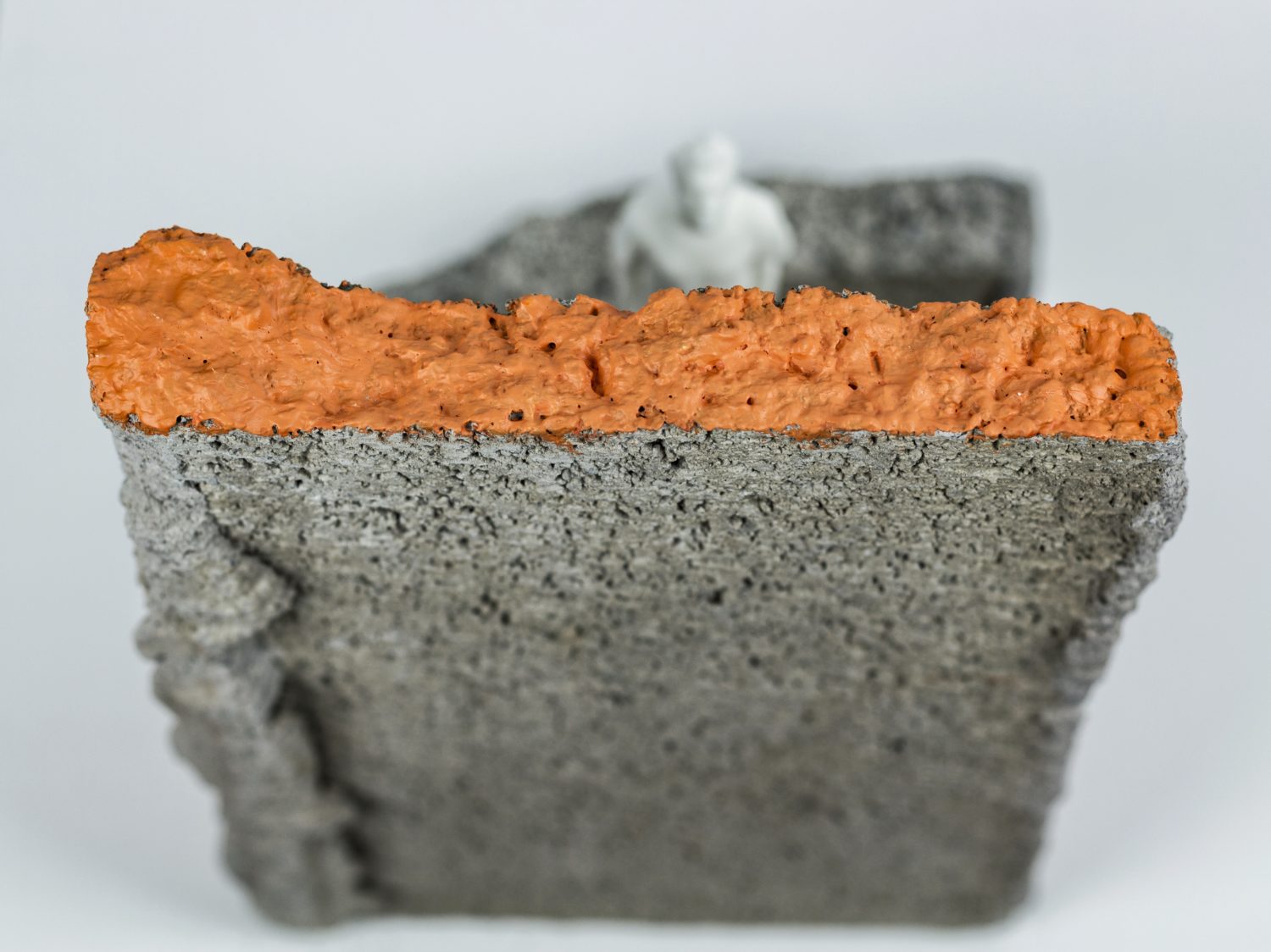
A broken block of concrete, cut in an L-shaped section like the corner of a building, becomes the stage for a single white resin figure. The man stands in the hollow with his hands in his pockets and his head tilted upward, facing a wall several times his height. The concrete keeps the marks of demolition: porous aggregate, ragged edges, a coarser band where a floor slab once met the wall. Only on the top edge, out of the figure's sight, does a crust of bright orange appear, as rough as the stone beneath it. The piece recalls both the architectural model and the Romantic figure seen from behind before a vast landscape, here replaced by a slab of rubble. At 35 centimetres high, it reads as a monument.
Concrete is the material of postwar cities, of social housing, ring roads and office towers, and grey has become the colour of urban routine. The fragment looks torn from such a building, a section of wall and floor with no windows. The small man inside it, in plain trousers and a T-shirt, stands like a resident or a commuter waiting for something to change. The orange layer on top suggests that the grey block once carried colour, perhaps a painted façade, now visible only from above. One can read in this a remark on how cities are distributed: from the street, the inhabitant meets mass and weight, while colour, view and openness belong to those who look from higher up.
The figure's posture is calm rather than fearful. Hands in pockets, weight on both feet, he simply looks up, and that upward gaze carries the emotional content of the piece. He cannot see the orange edge; the viewer can. This difference in viewpoint creates a gentle tension, the sense of knowing something that the person inside the situation does not. Many people live in a similar state, surrounded by what seems a uniform grey of duties and habits, unaware that the same wall, seen from another position, is warm. The title implies that greyness is partly a matter of where one stands. Leaning over the sculpture, the viewer is invited to imagine that wider view as available to themselves too.
At first glance it is just a chunk of rubble on a plinth, the kind of debris a renovation leaves behind. Then a tiny white man appears at its foot, looking up at the wall as if at a cliff. Only when you lean over the piece do you see it: the top of the block is bright orange, rough and alive, invisible from where he stands. Few objects express the mood of grey days in grey cities so economically. At a moment when many people describe their working lives in the language of burnout and flatness, the sculpture makes a quiet proposition, more practical than optimistic: the colour may already be there, one level up, waiting for someone to climb and look.