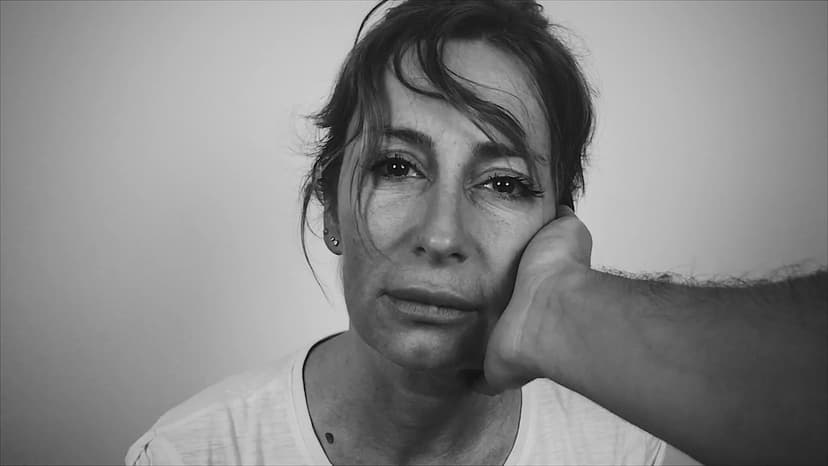
The image is a tight black-and-white close-up, framed like a portrait photograph against a blank wall. A woman looks straight into the lens, eyes wet, strands of hair loose across her forehead. From beyond the right edge of the frame enters a man's forearm, hairy and muscular, its fist resting against her cheek. The gesture is held still, and that stillness makes it impossible to read with certainty: the fist could be a blow arrested at the moment of impact, or a hand supporting a tired head. Monochrome removes the distraction of colour, leaving skin, light and tears. The anonymous arm, cut by the frame, recalls the way older painting introduced the hand of God or of fate from outside the picture.
A man's arm, a woman's face, a fist: the composition draws on the familiar visual vocabulary of campaigns against domestic violence, yet withholds the narrative they usually supply. There is no bruise, no slogan, no aggressor's face. The man exists only as an arm entering from outside, which is how many social forces act on individual lives: anonymous, external, physically felt. Read with its title, the image suggests that people are shaped by hands they did not choose, those of parents, partners, employers and circumstance. The woman's direct look at the camera also matters socially. She is not presented as a victim to be pitied but as a witness, addressing whoever watches and asking them to take a position.
What makes the image hard to leave is its ambiguity. The fist against the cheek is the shape of a punch, but the pressure seems gentle, and her head leans into it slightly, as one leans into a palm. Many relationships hold exactly that confusion, in which the person who hurts is also the one who holds, and attachment survives alongside fear. Her gaze is exhausted rather than terrified, the look of someone who has cried and is now simply waiting. The viewer stands where the camera stands, face to face, and may feel addressed, accused or recognised. Each person tends to complete the scene with their own history, which is why the same frame can read as comfort to one and threat to another.
A woman with red-rimmed eyes stares into the camera while a man's fist rests against her cheek. The picture arrives with the force of a news photograph, then slips out of that category: there is no bruise, no setting, only a plain wall and two bodies. Public conversation in recent years has taught many people that abuse can be quiet, made of control and pressure rather than visible blows, and this video installation looks exactly like that kind of harm, hard to prove and easy to overlook. Nothing in the frame is sensational, and that restraint is what makes it difficult to dismiss. The black and white gives it the weight of evidence, as if the image came from a case file rather than a gallery.