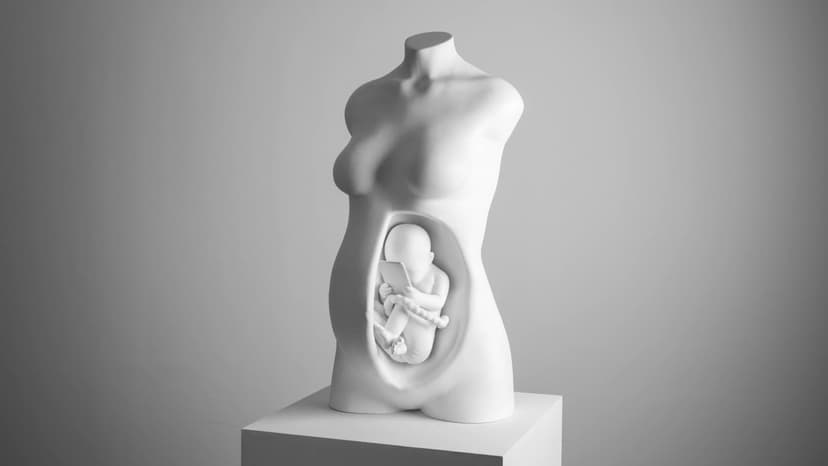
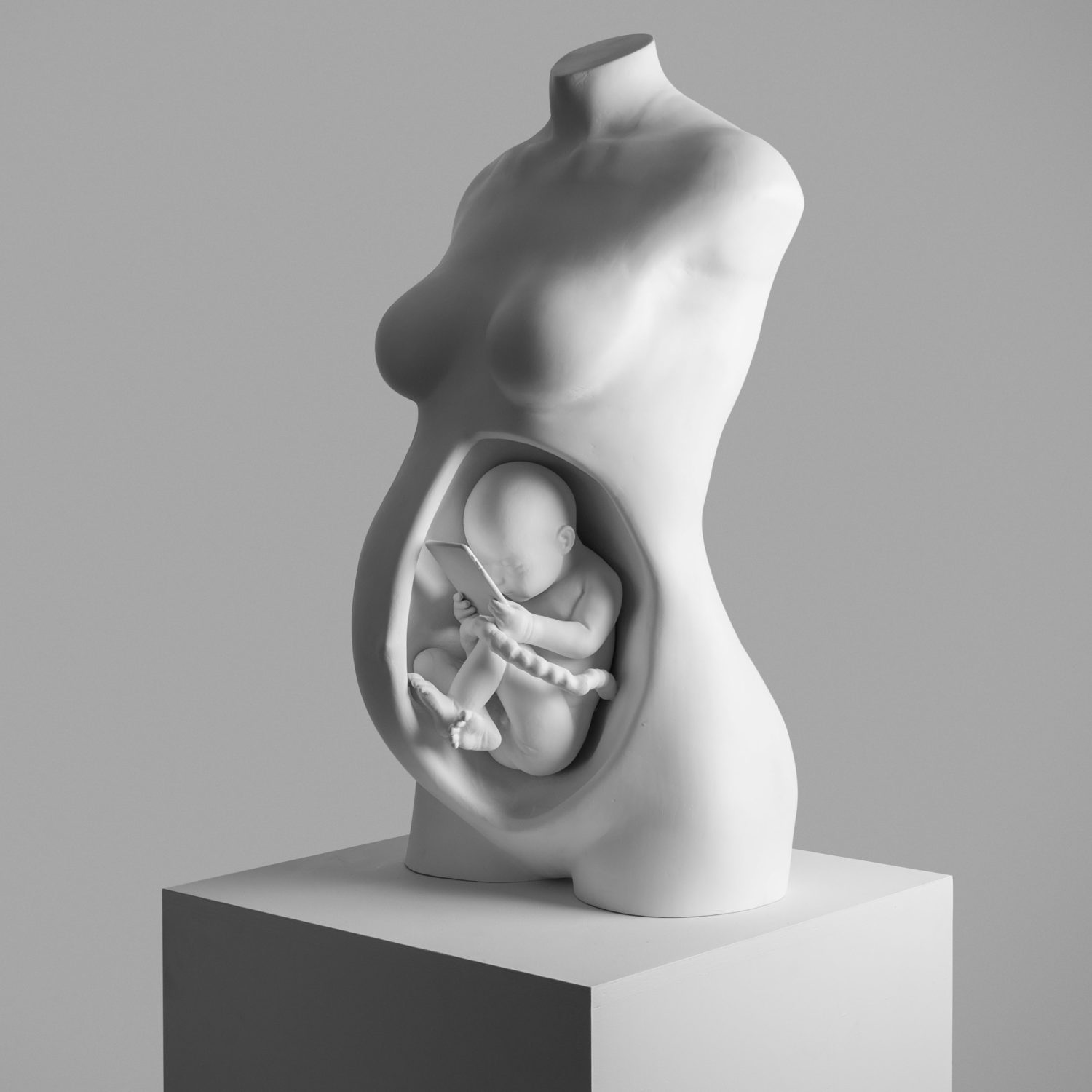
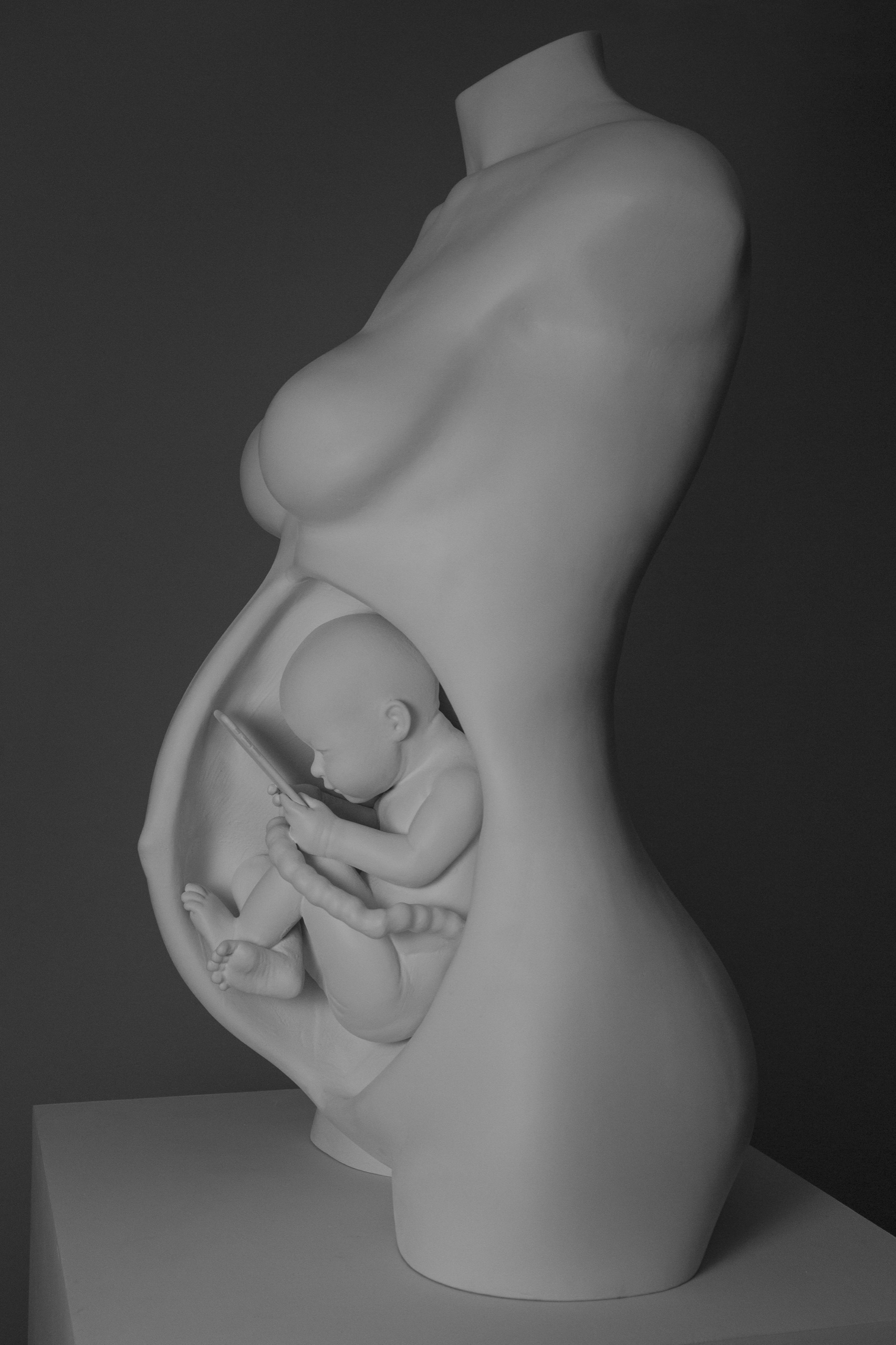
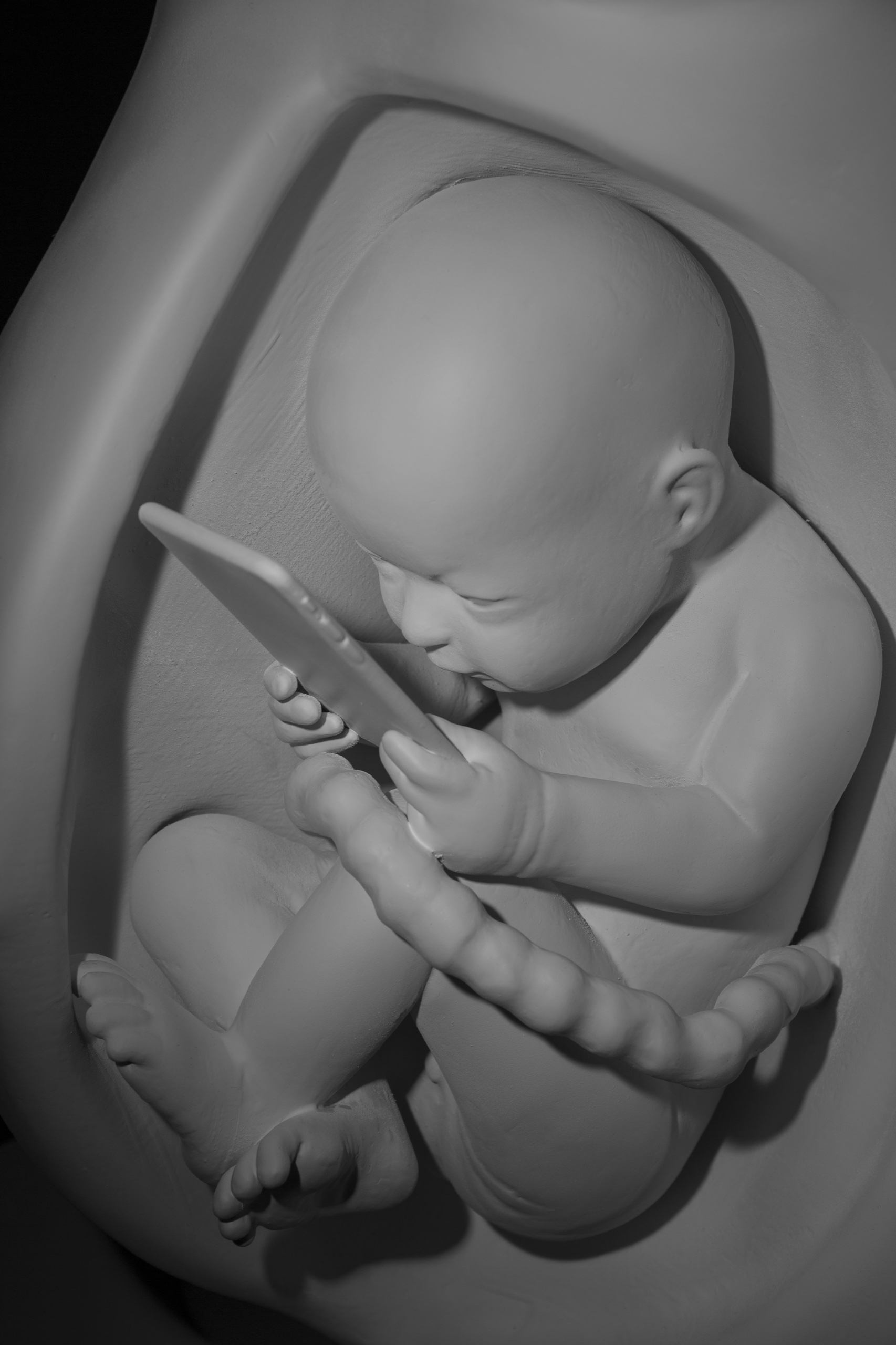
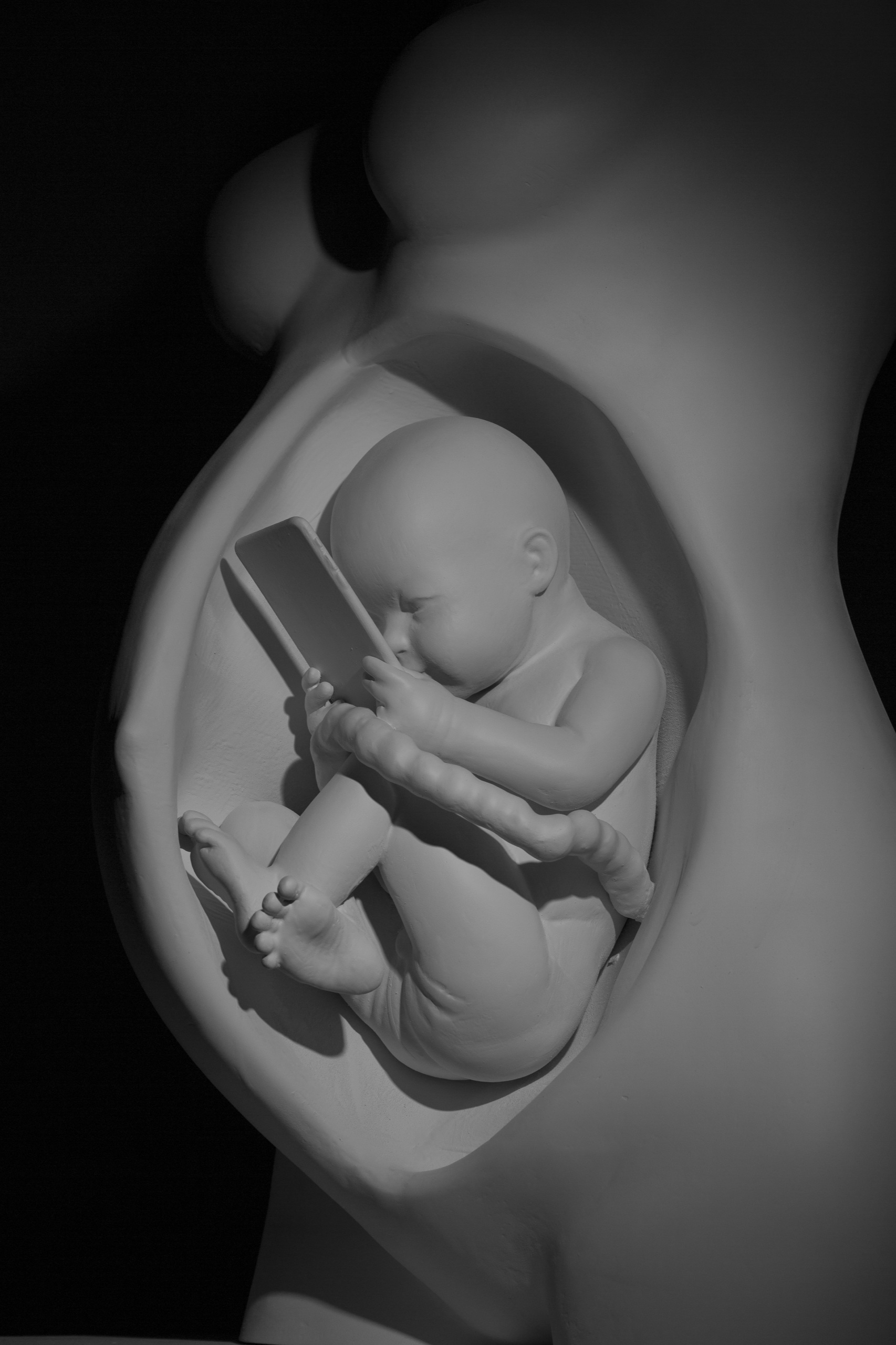
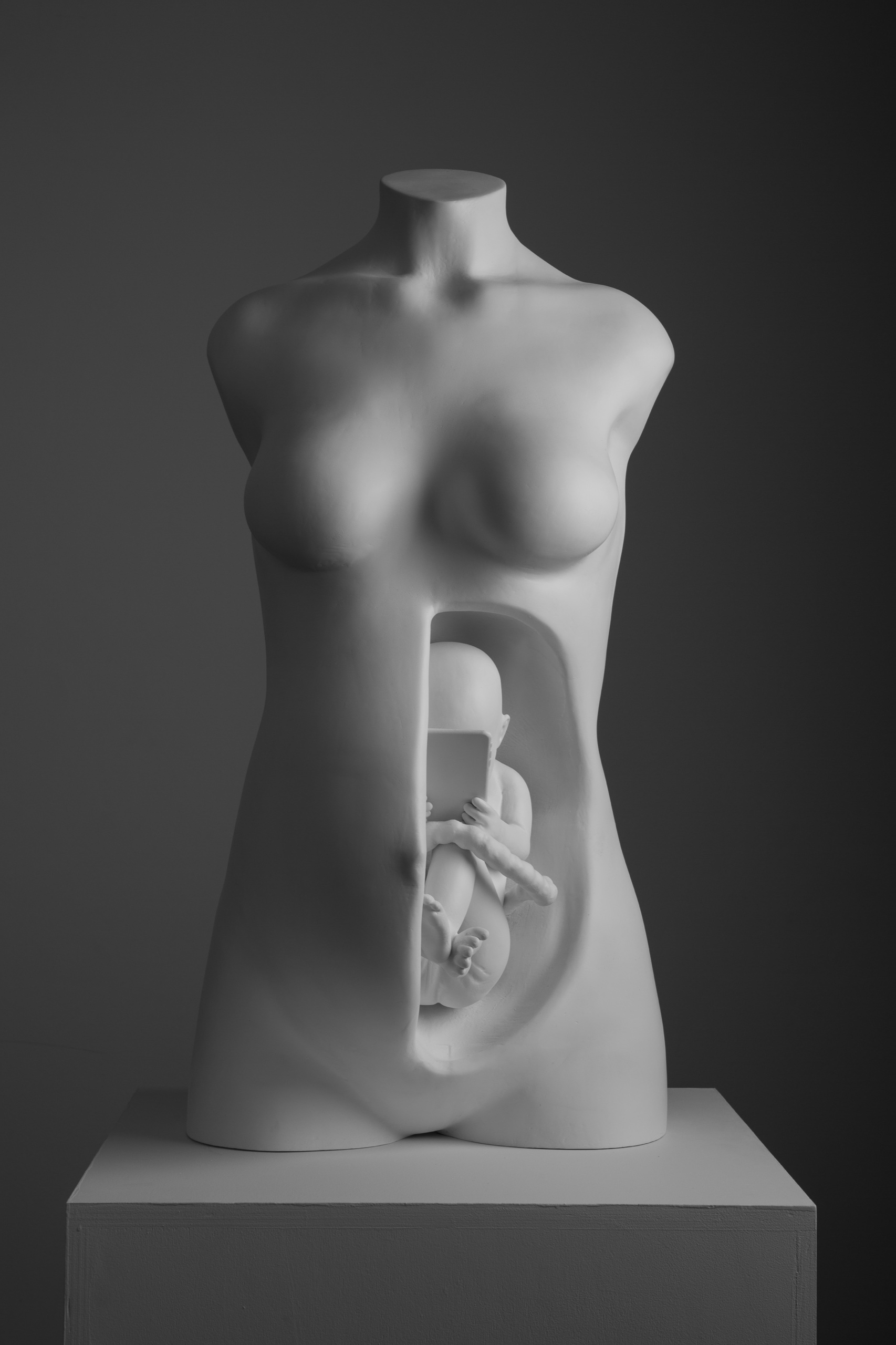
The sculpture takes the form of a classical torso, headless and armless like a fragment of ancient statuary, but its matte white resin and smooth surfaces belong to anatomical models and industrial casting rather than marble. An oval opening cut into the pregnant belly reveals the fetus in the curled position of late gestation, rendered with tender precision: the soft folds of the legs, the splayed toes, the heavy head bent forward. Its hands grip a smartphone close to its face, and the umbilical cord runs from the navel up toward the same hands, almost like a charging cable. The cutaway recalls the opened bodies of Renaissance anatomical plates. Set on a plinth at roughly life size, the work turns the most protected space of the body into a display case.
For most of history the womb has stood for the one space untouched by the outside world, a private interior that even the family could only imagine. The sculpture places a device there, where the first relationship of a human life is formed. The cord that once defined dependence on the mother bends toward the phone, suggesting a transfer of attachment from a body to a network. The title is deliberately double: connection means both the bond between mother and child and the signal that keeps a device online. Seen this way, the work weighs which of the two is becoming the primary environment in which new generations grow, and how families might negotiate that shift from the very beginning.
The fetus's absorption is the most unsettling detail. Its eyes are lowered to the screen, its head inclined in the posture many adults adopt on trains and sofas, and its whole body is curled around the device as if around a source of warmth. Early attachment, in psychological terms, depends on attunement: rhythm, voice, the mother's heartbeat. Here that dialogue seems already interrupted, the child turned toward something that responds without feeling. The mother has no face, so her experience remains unknown, which leaves the viewer free to project guilt, tenderness or fear. A parent may recognise themselves with a small jolt, seeing in the fetal pose their own habit of disappearing into a screen while someone close is waiting.
Long before a child says its first word, it may already know how to swipe. This sculpture takes that observation to its most literal extreme: a white resin torso of a pregnant woman, cut open to reveal a baby curled in the womb, scrolling a smartphone. The image is funny for half a second, and then it is not. Its strength lies in a familiar detail, the bowed head seen at every bus stop, transferred to a being that has not yet breathed air. As arguments about children and devices move from parenting forums into school rules and legislation, the piece works as shorthand for the whole debate. How early, it seems to ask, does the screen begin to shape who we become?