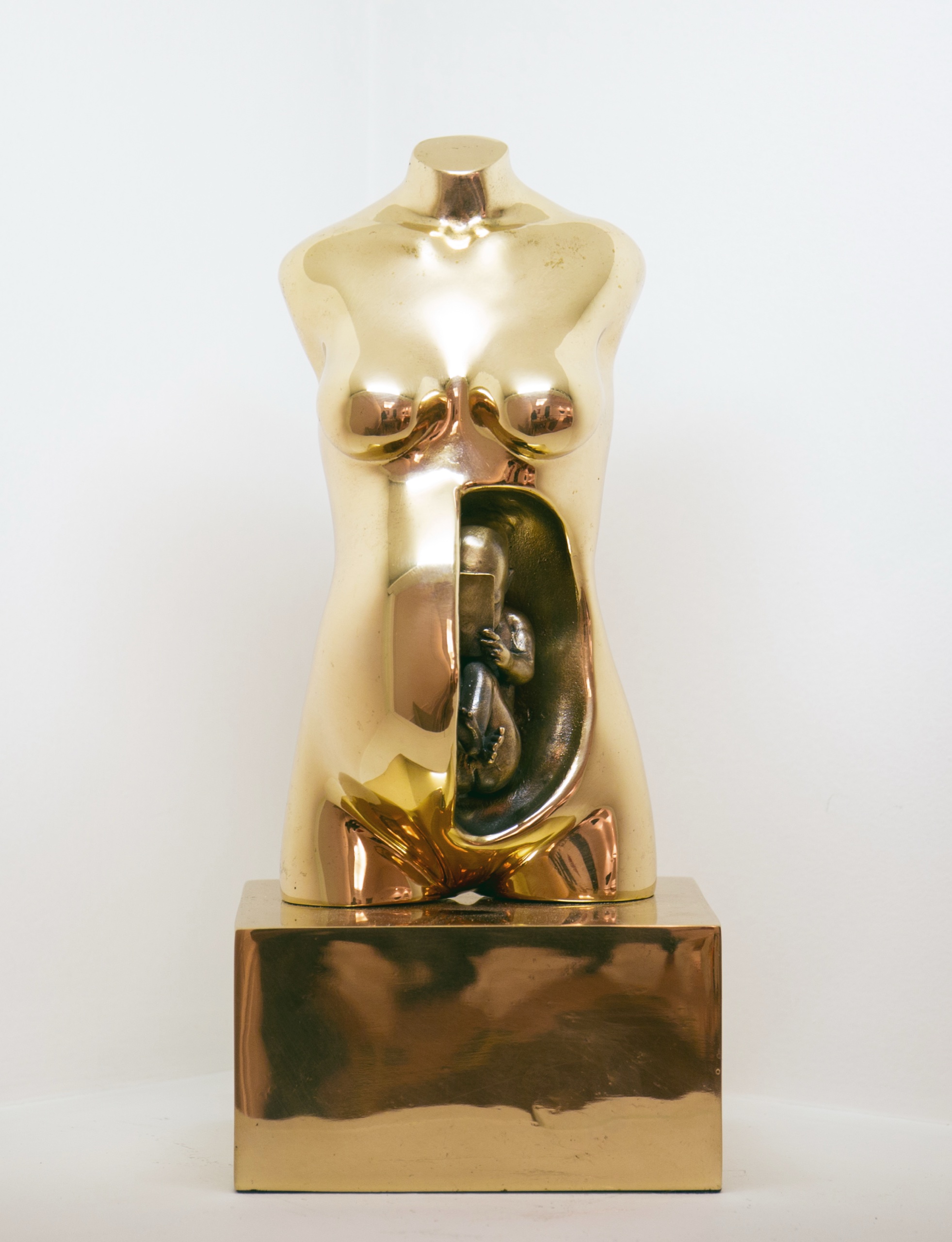
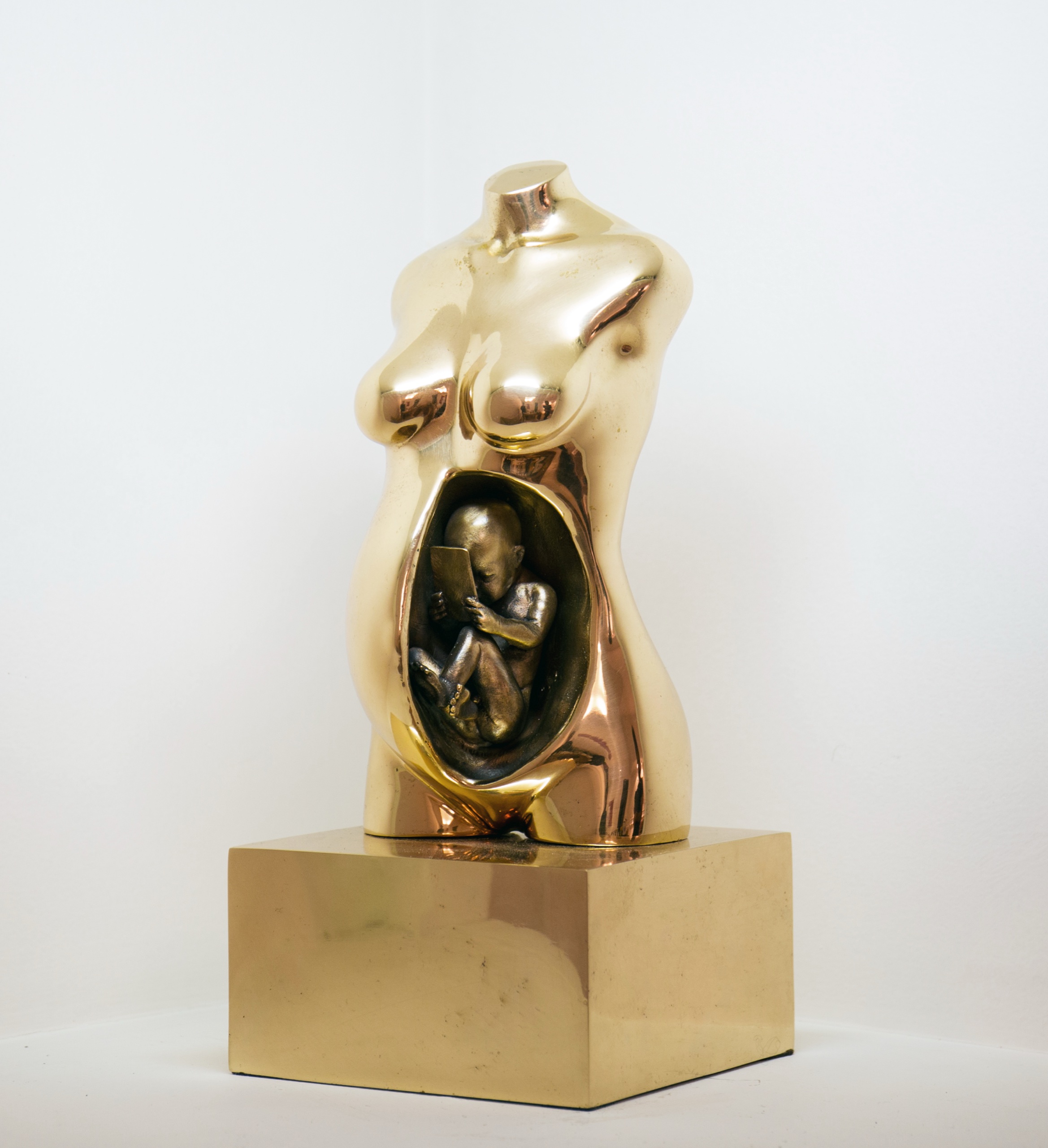
The format is that of the classical fragment: a female torso without head or arms, cut at the thighs and set on a square base, like the damaged Venuses of museum collections. Its surface is polished to a mirror finish, so that the room slides across breasts, hips and back. In the abdomen an oval opening reveals the womb, and inside it, in a darker, matte patina, a curled foetus holds a small rectangular screen up to its face. The contrast of finishes does the narrative work, gleaming exterior against shadowed interior, and the anatomical cutaway recalls the didactic models of obstetrics. At 30 centimetres high, the bronze keeps the intimacy of a devotional object meant to be looked at closely.
Screens now enter a child's life earlier than words, handed over in prams, at restaurant tables and in waiting rooms. The sculpture pushes that timeline to its limit: the device is already in hand before birth, as if connection were inherited along with the body. One can read in it a society in which the first relationship is no longer exclusively with the mother but shared with a technology that the family itself has normalised. The mother has no face and no arms; she is reduced to a shell, a beautiful and impersonal container. The generational question is plain: what does it mean to grow up in a world where attention is claimed by devices from the very start?
The prenatal stage is often imagined as the purest form of attachment, a closeness without distance. In this torso the foetus turns its gaze away from that closeness and towards a glowing rectangle, its knees drawn up in the same posture people adopt when absorbed in a phone on a sofa. The image touches a fear many parents carry, that the bond with a child might be mediated or diluted before it has even formed. It also speaks to adults: the curled body suggests a regression, the way a screen can become a soothing substitute for the womb itself. The polished surface returns the viewer's own reflection, adding an uncomfortable sense of being implicated in what is shown.
Before the first cry, the first scroll. A small polished bronze shows a headless female torso, gleaming like a trophy, with a window cut into the belly; curled inside, in darker metal, a foetus stares at a tablet. Federico Clapis renders the joke in the most solemn material sculpture has, and that is what makes it stick. Debates over toddlers and screen time, digital pacifiers and the youngest users of social platforms have not gone away. The work turns them into a single, almost biblical image of a generation born connected, with the warm light of the device replacing the darkness of the womb.