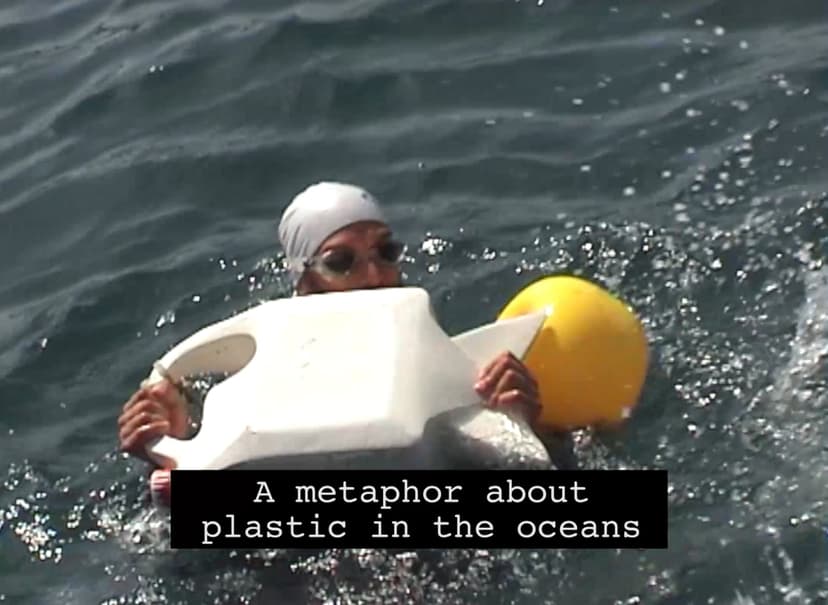
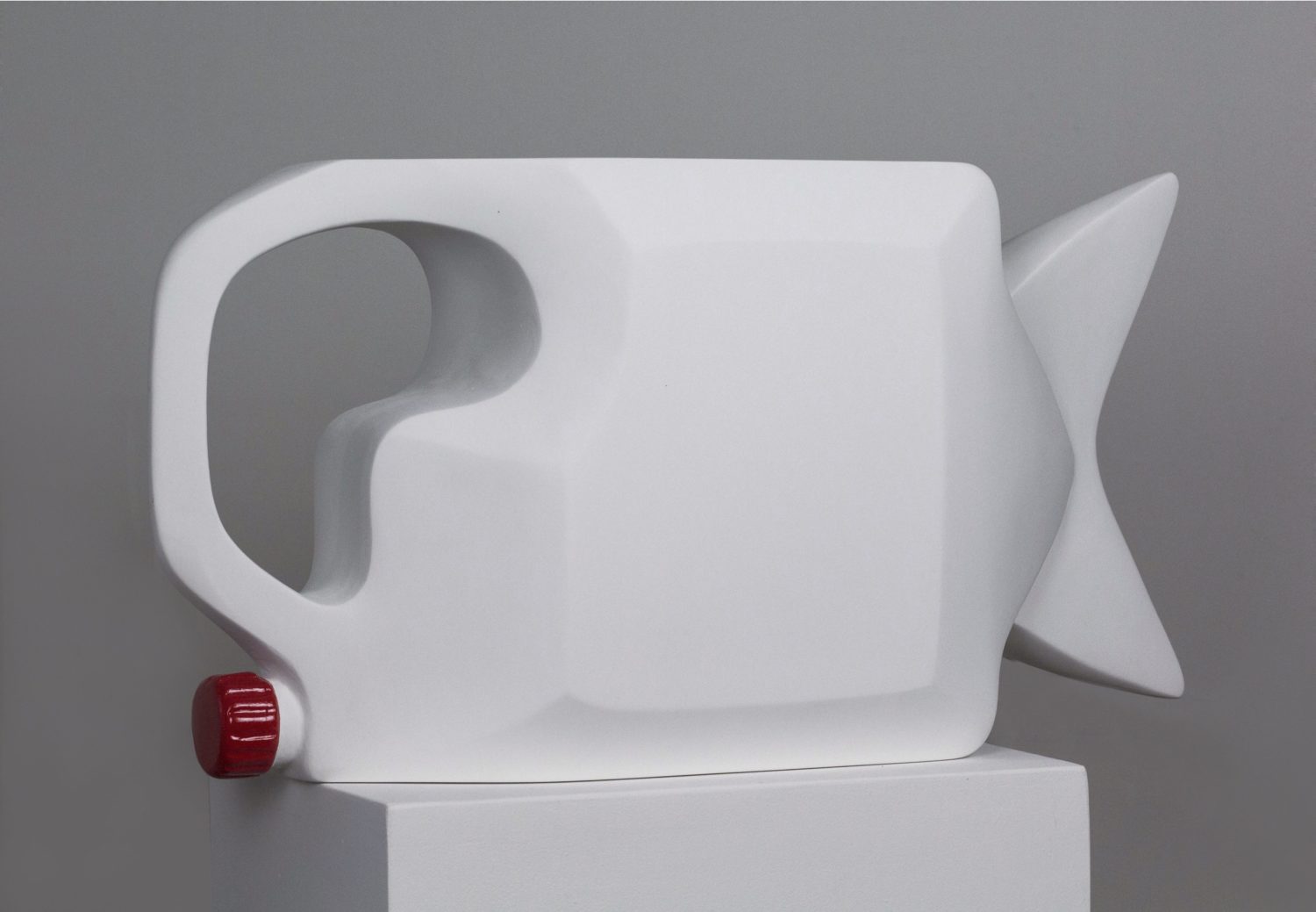
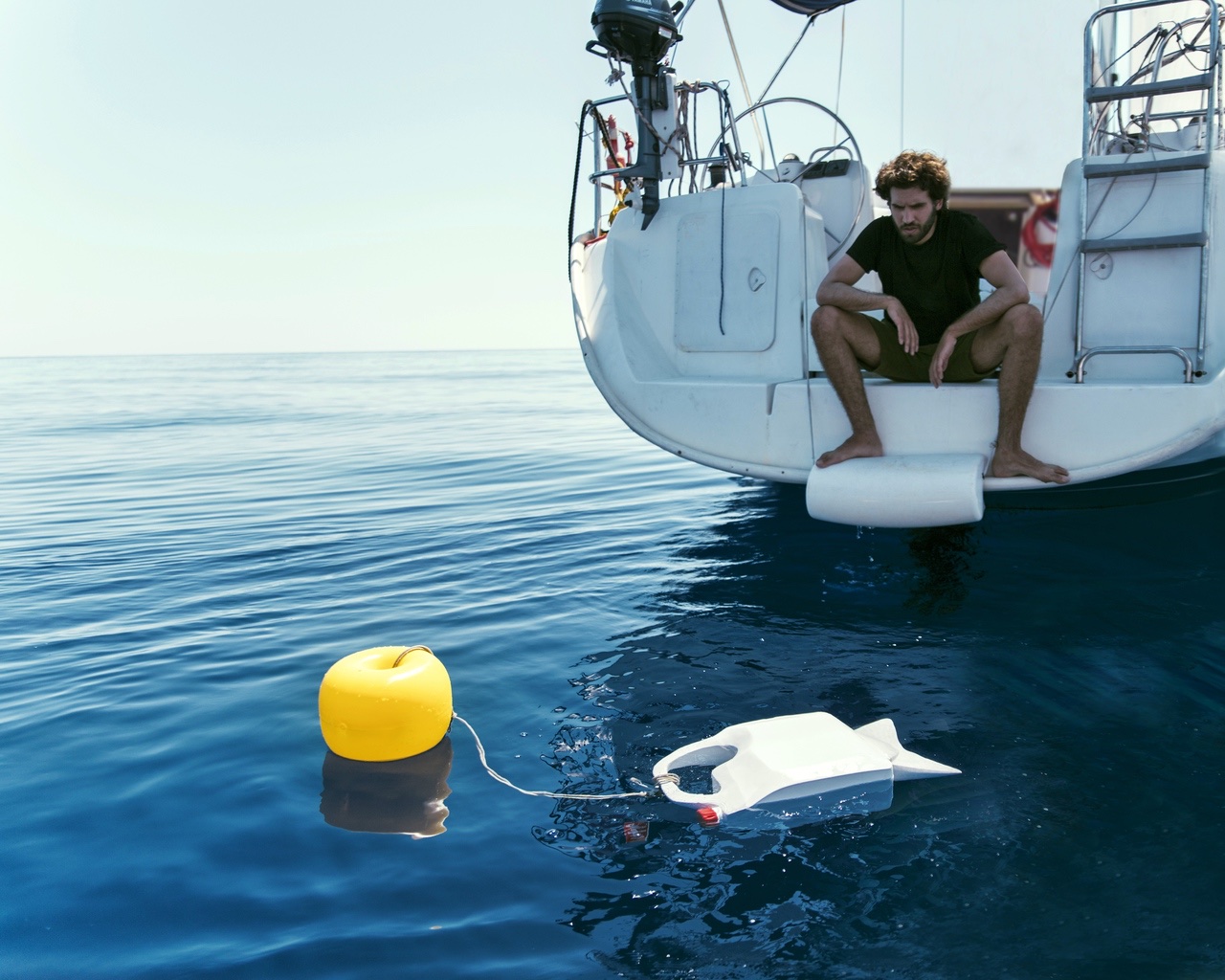
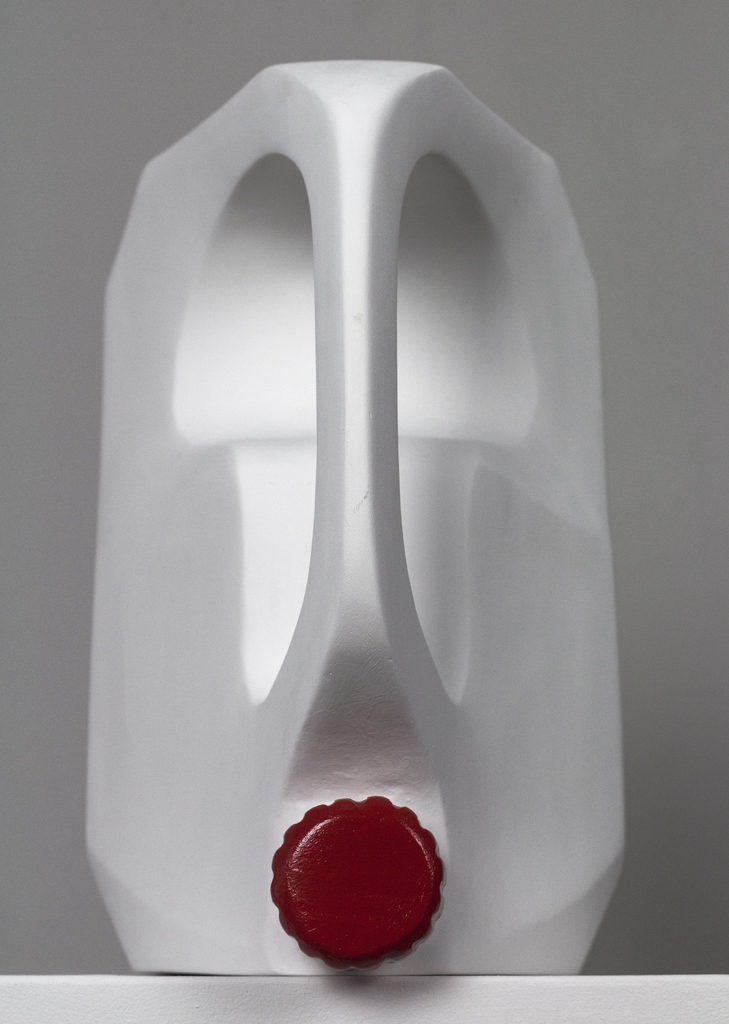
On a white plinth the sculpture reads at first as a household jerrycan: squared body, bevelled edges, a looped handle and a small red screw cap. At the back, though, the container tapers into a forked tail, and the handle's opening becomes the curve of a gill or an eye. The hybrid is resolved with the restraint of industrial design, in a matte white that recalls both moulded plastic and the purity of museum plaster. Seen head-on, the form turns almost into a mask, the red cap set like a mouth. The photographs then move the object into the sea, moored to a yellow buoy or lifted by a swimmer, so that the work exists in two registers at once: the gallery specimen and the creature in its supposed habitat.
Everyday plastic containers, bought full and thrown away empty, are among the most common objects found in the sea, and the sculpture imagines the end point of that cycle: waste so abundant that it has become a species. The fish is not stuffed with plastic or wrapped in it; it is made from its shape, a new animal born of consumption. The image questions a culture that measures nature through its products, where a coastline is judged by what floats on it. The artist himself, sitting barefoot on the stern of a sailing boat and watching the jerrycan-fish drift on its line, embodies a leisure that depends on the same sea it pollutes, and places the author inside the problem rather than above it. Responsibility here is quiet and shared, never assigned to a single villain.
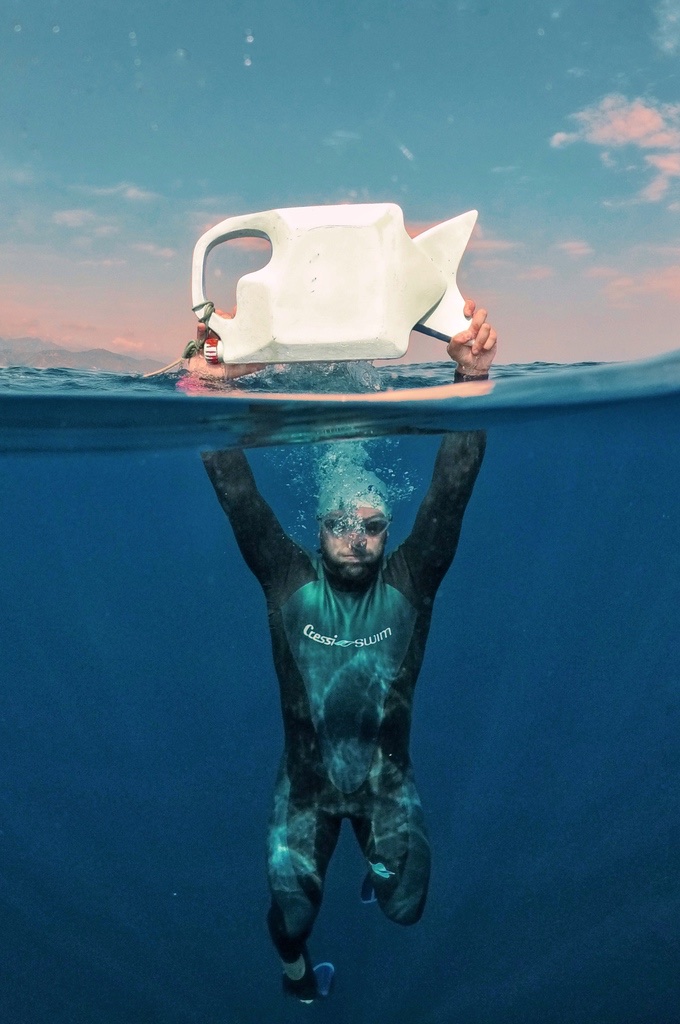
There is something endearing about the creature, and that is the troubling part. The tail makes the container cute, almost a toy for a bath, and the mind accepts the hybrid with surprising ease. That readiness mirrors a mechanism of adaptation: what we see every day stops alarming us and is absorbed into the landscape as if it had always belonged there. The underwater photograph adds a different feeling, the swimmer holding the fish above the surface like a trophy or an offering, his body suspended in deep blue while his eyes look straight at the camera. Pride and complicity coexist in that pose, and the viewer is left between amusement and a dull sense of loss.
Scientists warn that by weight there may one day be more plastic than fish in the oceans. Federico Clapis skips the statistics and simply merges the two: a white jerrycan, red cap and all, with a fish tail growing out of its back. On a pedestal it looks like a design object; tied to a yellow buoy and bobbing beside a sailing boat, it looks like the catch of the future. One photograph shows a swimmer in a wetsuit raising it out of the water with both hands. The joke is gentle, the conclusion is not. If the sea is learning to produce creatures in our image, Tank Fish looks like a first specimen.