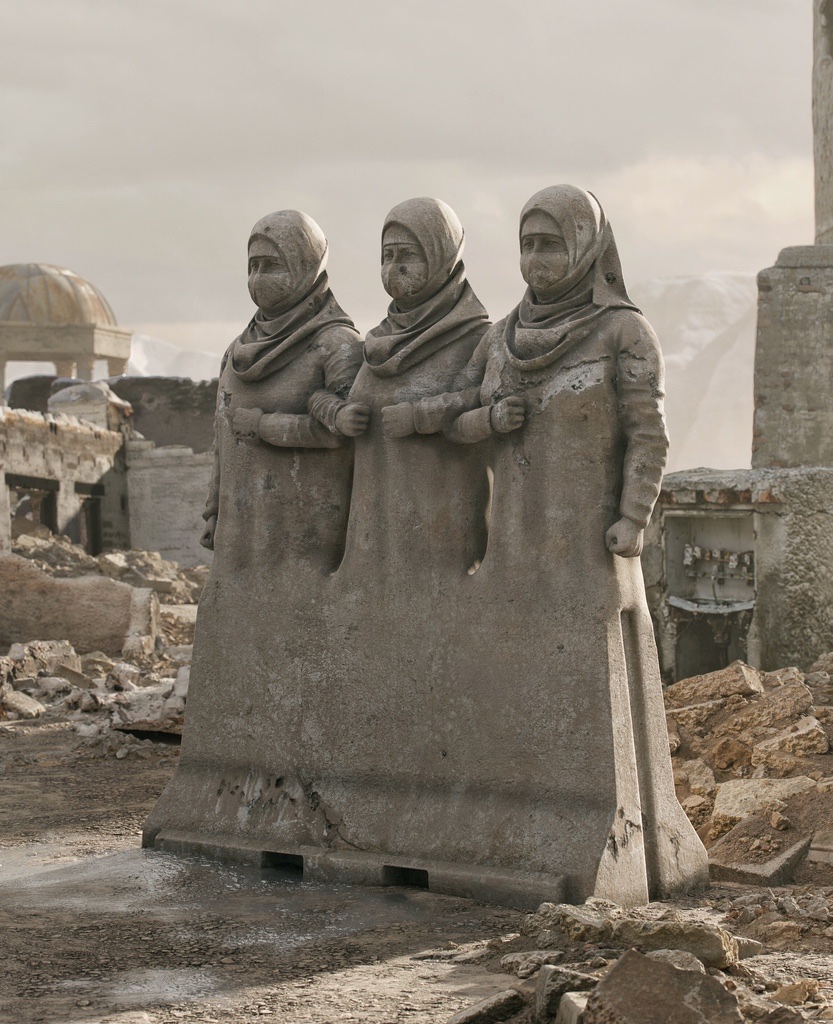
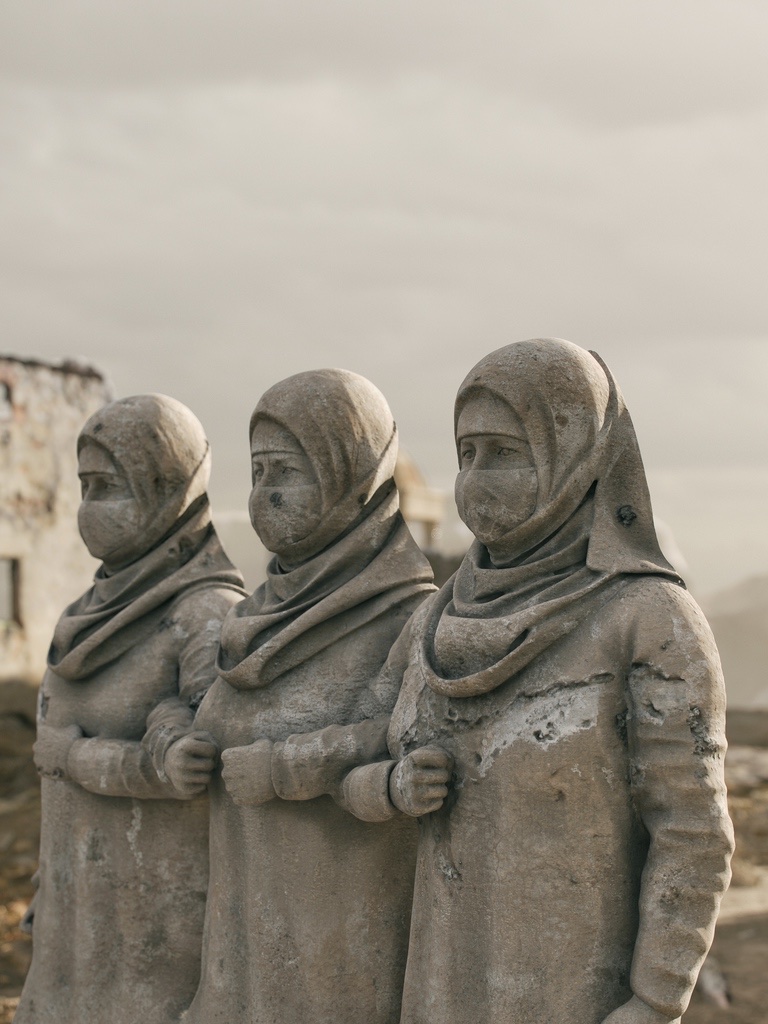
Three female figures stand shoulder to shoulder, each in a long tunic and a headscarf drawn around the face, their mouths and noses covered by masks. Arms are linked at the elbow, fists closed against the chest, in a gesture of compact resistance. From the waist down the three bodies fuse into a single slab whose profile is that of a concrete traffic barrier, with its flared base and the slots used for lifting. The stone surface is worn, flaked and stained as if exposed for decades, and the setting of ruined buildings and a cracked dome reinforces the archaeological tone. The group recalls the commemorative statuary of war memorials and the ancient type of the three Graces, here reconfigured as a wall.
The installation turns a familiar urban object into a human chain. Concrete barriers mark checkpoints, protest routes and cordoned zones; here the barrier is made of women who choose to hold one another. Their covered heads and masks evoke contexts where faces are hidden for faith, for protection from illness or dust, or for safety from surveillance, and the work does not reduce these to one meaning. What it affirms is collective agency: in places shattered by conflict or disaster, informal networks of women often keep daily life standing, caring for the wounded, the old and the young. The title names this bond explicitly. Sisterhood is shown not as sentiment but as infrastructure, as solid and necessary as the blocks that hold a road open.
The eyes of the three women remain visible above the masks, and they look in the same direction, steady and unhurried. That shared gaze communicates a calm that is earned, the composure of people who have seen damage and decided not to scatter. Psychologically the group embodies a basic truth about resilience: fear is survivable when it is held together with others. The linked arms make each figure lean on, and support, the next, so that no single body carries the full weight. Facing them, the viewer may feel both protected and stopped, invited to join the chain or confronted by a line that cannot be crossed. The masks keep the figures anonymous, which allows anyone to recognise a sister, a mother or themselves.
Among the rubble of a ruined town stands a monument that seems to have survived everything around it: three women, veiled and masked, arms locked, their bodies welded into one concrete roadblock. The image speaks to a time crowded with pictures of devastated cities, of evacuation lines and of improvised barricades, and it places at their centre the people who rarely get statues. History usually casts its heroes in bronze on horseback; this group is anonymous, weathered and immovable. The idea is direct enough to travel without explanation, and the material does the rest, making solidarity look less like a hashtag and more like something that can stop a truck. It is a memorial for the present tense.