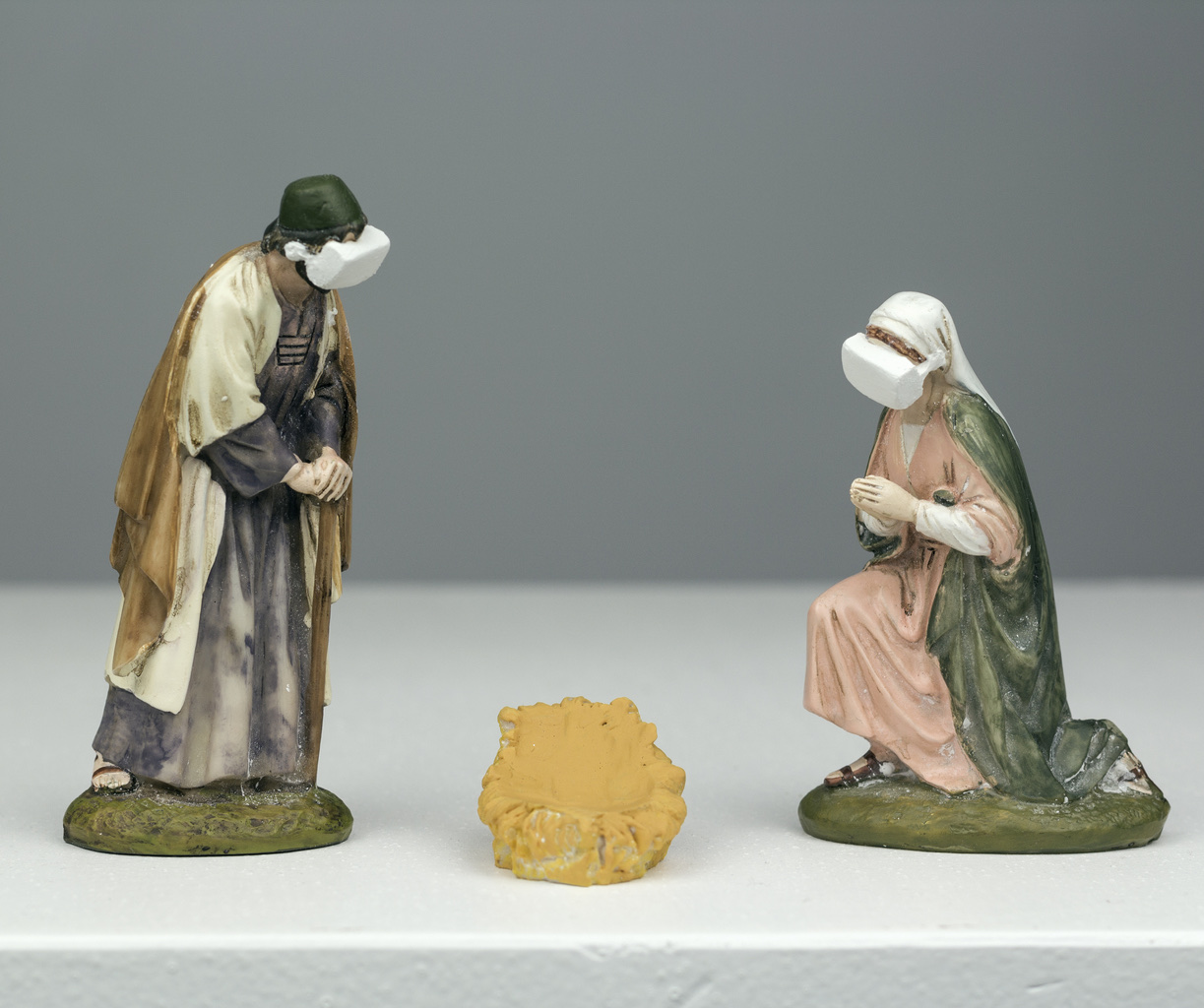
Two painted figurines from a traditional nativity scene, in muted ochres, violets, pinks and greens, stand on a white shelf. Joseph bends over his staff; Mary kneels with her hands joined in prayer. Both wear small white virtual reality headsets, modelled in a smooth, unpainted material that contrasts with the hand-coloured folds of their robes. Between them lies the manger, filled with straw and empty. The composition keeps the triangular symmetry of countless Adorations, the two parents inclined toward the centre, but removes its focal point. The scale, a few centimetres, is that of popular devotional craft made for the home, so the intervention feels like a quiet alteration of a domestic object rather than a monument.
The nativity scene is one of the most persistent domestic rituals of Christian culture, unpacked each December by families, parishes and schools, often in homes where faith itself has grown thin. The work catches that gap between form and content. Mary and Joseph keep the postures the scene demands, kneeling and bowing toward the centre, but their eyes are elsewhere, sealed inside headsets, and the manger they surround holds only straw. Secularisation, in this reading, does not abolish ritual; it empties it while keeping the choreography intact. The figures behave like many participants in collective ceremonies today, present in body and devoted in gesture, yet attending to something else. The title keeps the search open: the desire remains, only its object is missing.
Devotion is turned inward here, in an unexpected way. With their eyes covered, the two figures see nothing of each other or of the space between them, and their tenderness toward the child becomes a tenderness toward an image only they can perceive. The empty manger produces a small shock, an absence where a presence was expected, and the mind immediately tries to fill it. Perhaps the child is inside the headsets; perhaps it was never there. That uncertainty touches a familiar inner experience: wanting to believe, and not knowing where to look. The viewer, who can see the empty crib the parents miss, is left holding the absence on their behalf.
Mary and Joseph have finally caught up with the century. In this tiny sculpture, barely larger than a hand, the familiar couple of the Christmas crib kneel and bow as always, except that both wear virtual reality headsets, and the manger between them is empty. The joke is immediate; the second thought takes longer. Technology companies now describe immersive worlds with a vocabulary of presence, revelation and transcendence once reserved for religion, and their launches are staged with the solemnity of liturgy. The piece compresses that drift into a scene almost anyone raised with Christmas would recognise. It could pass for a novelty ornament, and that closeness to kitsch is precisely what lets it slip past our defences.