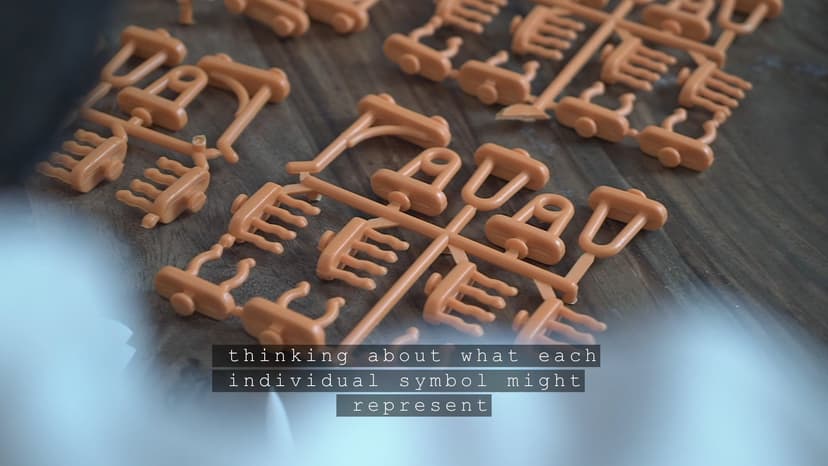
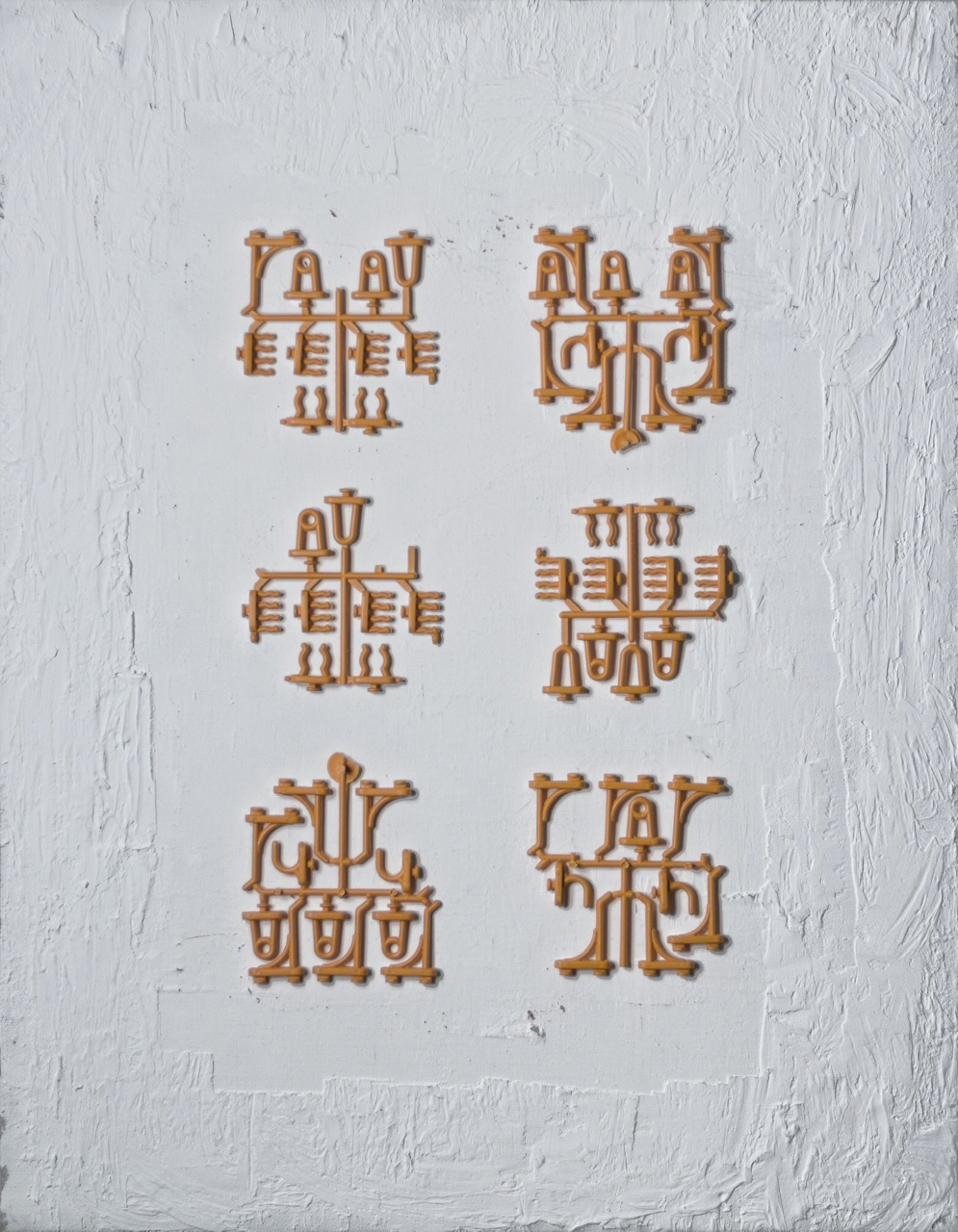
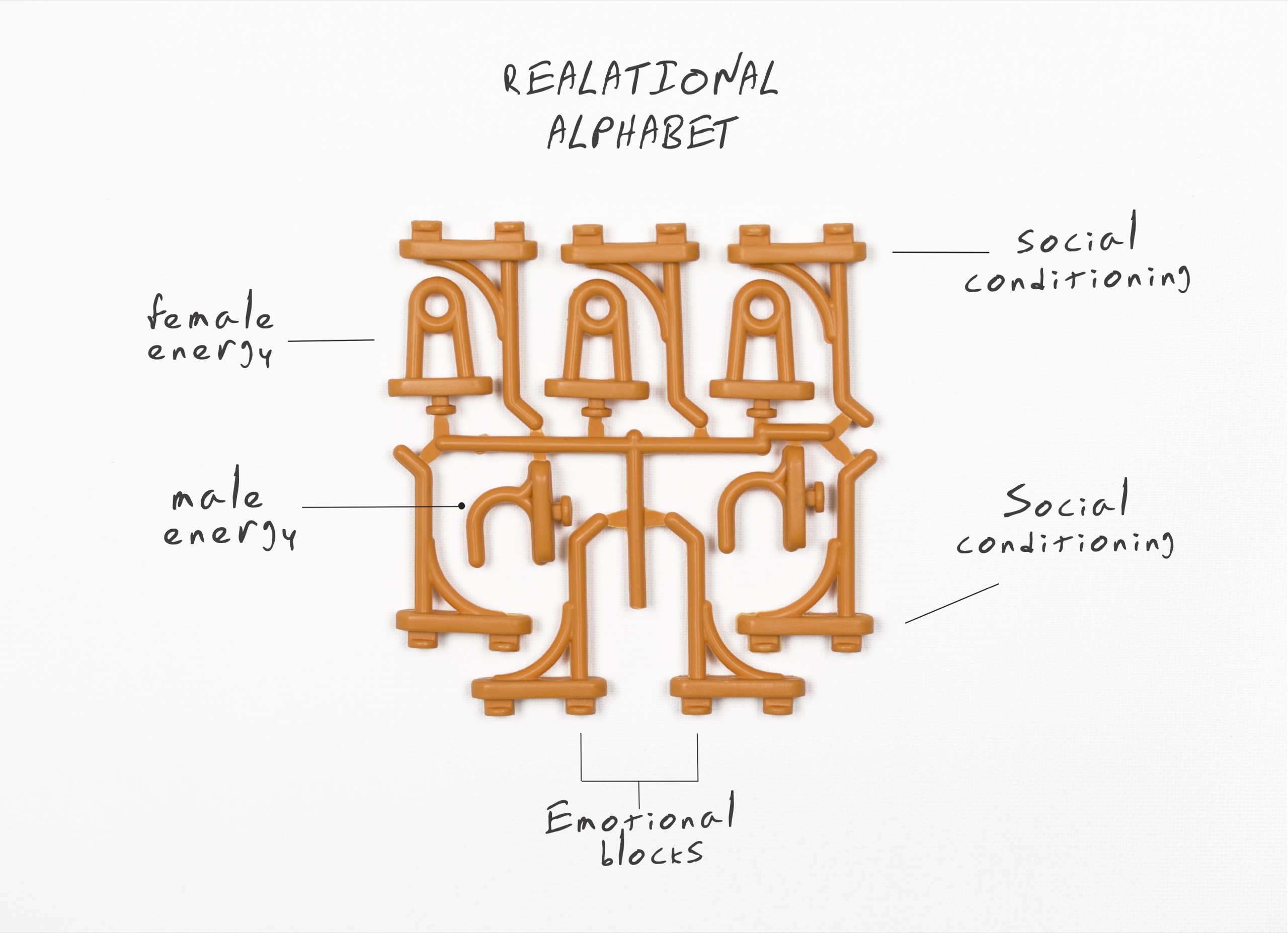
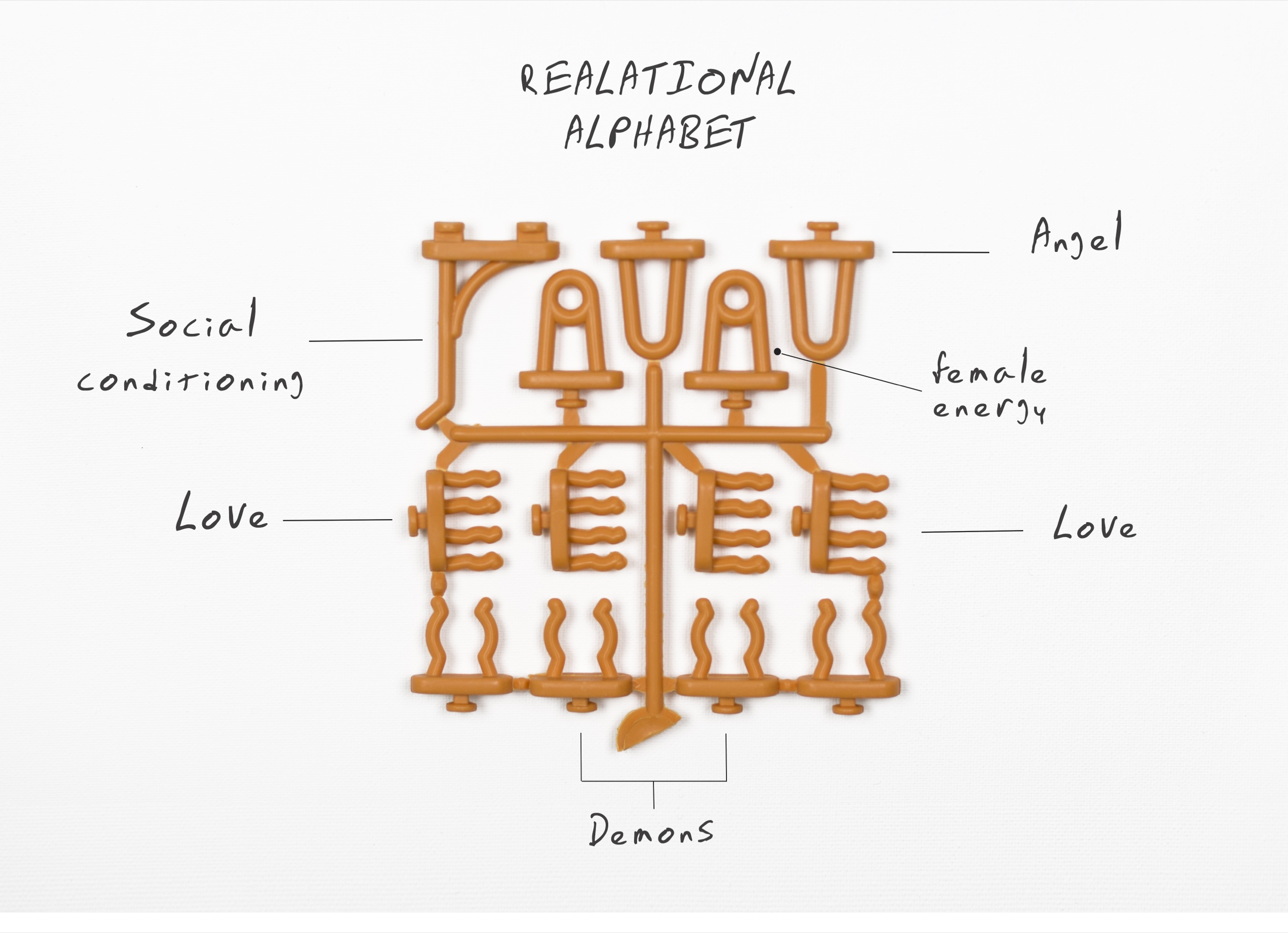
On a canvas covered with thick white acrylic, laid on in heavy, uneven strokes that leave a smoother rectangle at the centre, six ochre resin elements are arranged in two columns like the characters of a text. Each is built from the shapes of a plastic model kit, the frame or sprue that holds the parts before they are snapped off. Bells, hooks, rods and wavy forms join along straight channels into symmetrical glyphs. Accompanying diagrams name the components in handwritten capitals and script: female energy, male energy, social conditioning, emotional blocks, love, angel, demons. The work borrows the look of assembly instructions and of an undeciphered script, somewhere between hieroglyph and engineering drawing, and sets it on a ground as worked and tactile as plaster.
The model kit is a product of mass consumption: every part identical, every assembly prescribed by the manufacturer. Using it as the grammar of human relationships is a pointed choice. The diagrams place social conditioning at the edges of each glyph, in the brackets and frames that hold the other parts in place, as if the structure that keeps a couple or a family together were largely inherited rather than chosen. Gender appears as two kinds of component, female and male energy, which fit together only through the channels already moulded for them. What emerges is a gentle analysis of how culture standardises intimacy, supplying ready-made pieces and templates long before two people meet and try to build something of their own.
Psychology has long tried to map the inner life with diagrams, and this painting treats that ambition with a mixture of seriousness and irony. Its glyphs are made of named parts: love as rows of wavy lines, demons as twisting forms near the base, angels as cup-shaped pieces at the top. Each relationship becomes a configuration of these forces, with emotional blocks as solid feet that keep the structure from moving. The idea that any bond could be read like a word, letter by letter, is both comforting and unnerving. It is hard not to start deciphering which shape would describe a partner, a parent or a friend, and to notice which parts of one's own story have never been snapped free of the frame.
Anyone who built plastic models as a child will recognise the shapes at once: the brittle frames in which tiny parts wait to be twisted off and glued. On this canvas they have become the letters of a strange alphabet, six ochre symbols on a rough white field. Diagrams decode them with handwritten labels, from love and angel to demons and emotional blocks, giving the piece the tone of a user manual for feelings. At a time when dating apps, therapy vocabulary and online quizzes encourage people to describe relationships in terms of types, patterns and red flags, the work holds up a mirror to that habit. It is playful, tidy and slightly unsettling, as instructions for the heart tend to be.