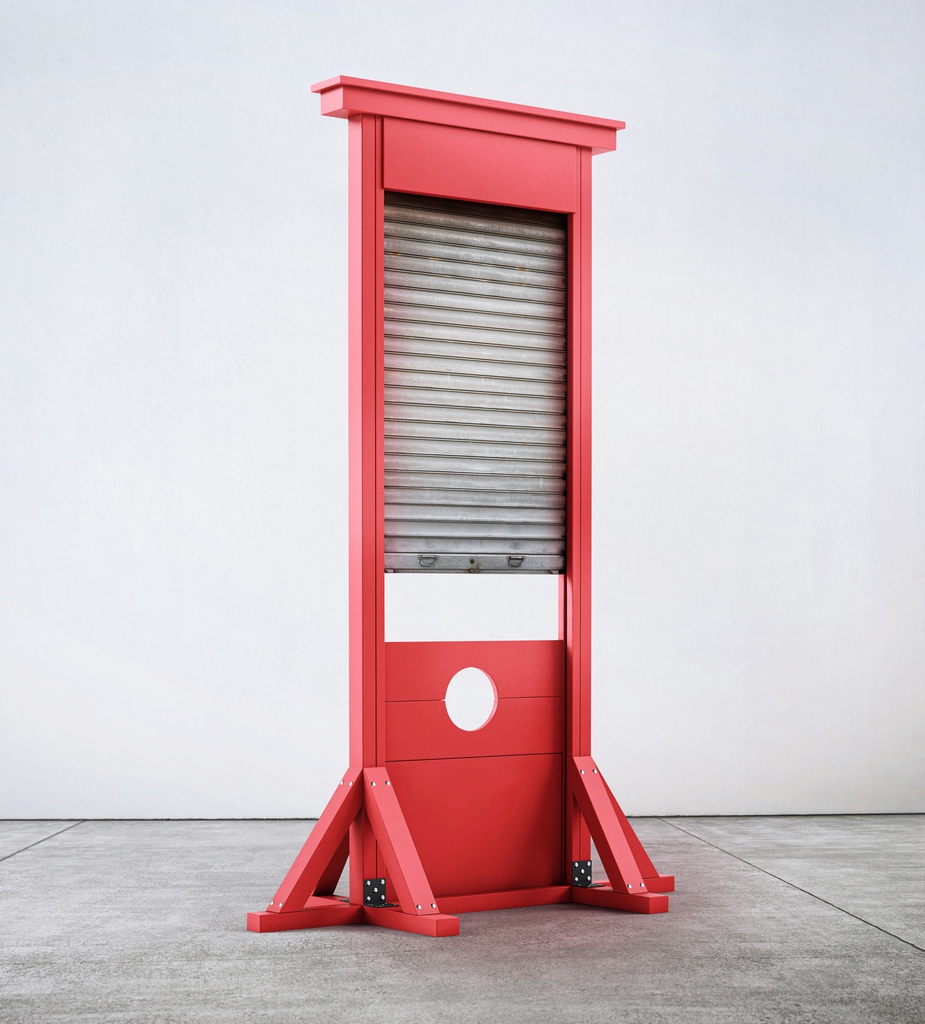
At more than two metres high, the sculpture adopts the full scale and carpentry of a guillotine: splayed feet braced with brackets, two tall uprights, a cornice, a lunette with its circular opening. Yet the falling blade has been replaced by a corrugated roller shutter, the grey galvanised kind that closes shops at night, complete with its two pull handles. Everything else is coated in a flat, even red, almost the colour of a toy or a fire extinguisher, so that the instrument of the Terror is drained of patina and reissued as a clean industrial object. The meeting of two ready-made forms, one historical and one ordinary, recalls the logic of the assisted readymade, while the strict frontality turns the piece into a kind of upright door that opens onto nothing.
The title borrows a phrase that in 2020 described areas under the strictest lockdown rules, and the substitution at the centre of the work makes the consequence literal: the shutter of a shop becomes the blade. Read socially, the sculpture is about livelihoods rather than bodies. Small businesses, bars and family workshops depend on the daily gesture of raising that metal curtain; when it stays down, a whole economy of neighbourhood relations stops with it. The guillotine, an emblem of public justice performed in the square, here suggests a different kind of collective sentence, impersonal and administrative, decided for the common good yet carried out on particular shopkeepers. The empty lunette waits for no one in particular, which is precisely the point: anyone with a counter and a till could be next.
The round hole at neck height is the detail that unsettles most. It is empty, and the viewer instinctively measures it against their own body. Standing in front of the piece, one feels the anticipatory dread of a blow that has not yet fallen, the specific anxiety of waiting for a decision that comes from above. The shutter adds a second, quieter fear: the closing of a space that held one's identity, routine and pride. For many people work is less a source of income than a way of knowing who they are, and losing it can feel like a small decapitation. The cheerful red softens nothing; if anything, its brightness resembles the forced composure people wear while the ground shifts beneath them.
Picture the sound every shopkeeper knows: the rattle of a metal shutter coming down at closing time. In Red Zone that sound becomes a death knell. A life-size guillotine, painted a flat, cheerful red, carries in place of its blade an ordinary roller shutter, handles and all. The joke lands quickly and then stops being funny. In a year when entire districts were shut by decree, the image condenses months of headlines about closed restaurants, emptied high streets and owners who never reopened. It does not take sides on whether the measures were right; it simply shows the cost as a single, heavy object. The economic side of a public-health emergency fits into very little here: one frame, one hole, one shutter.