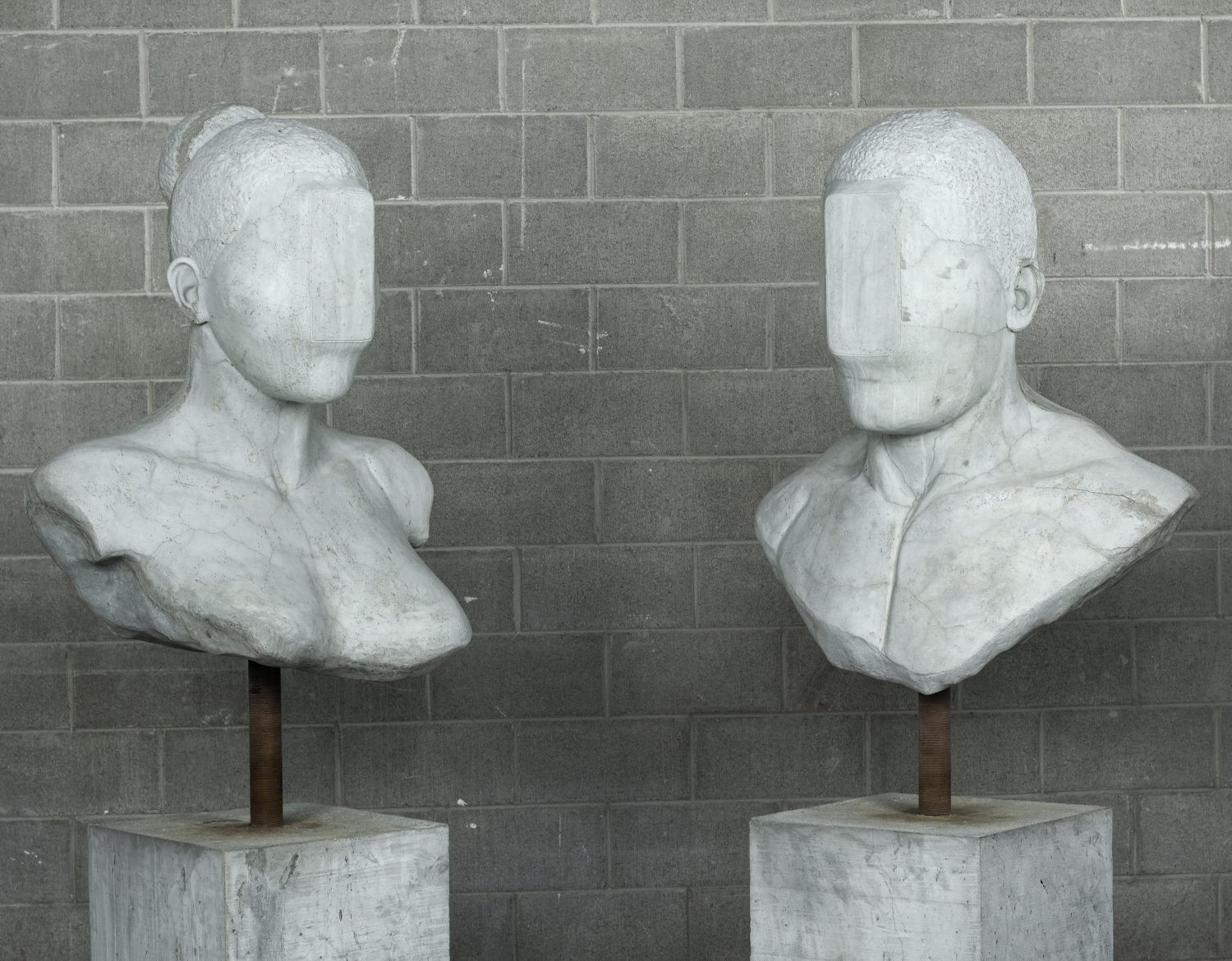
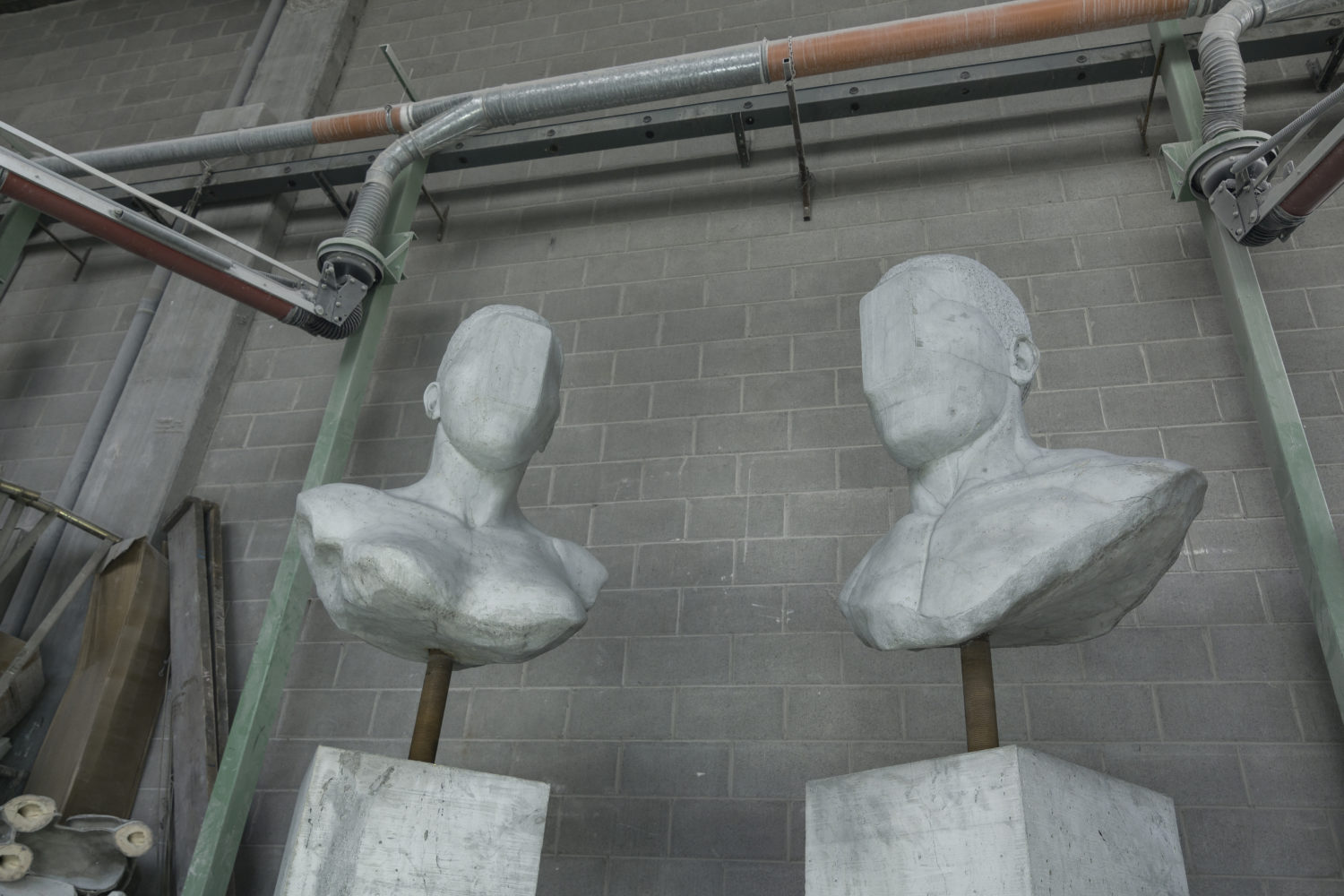
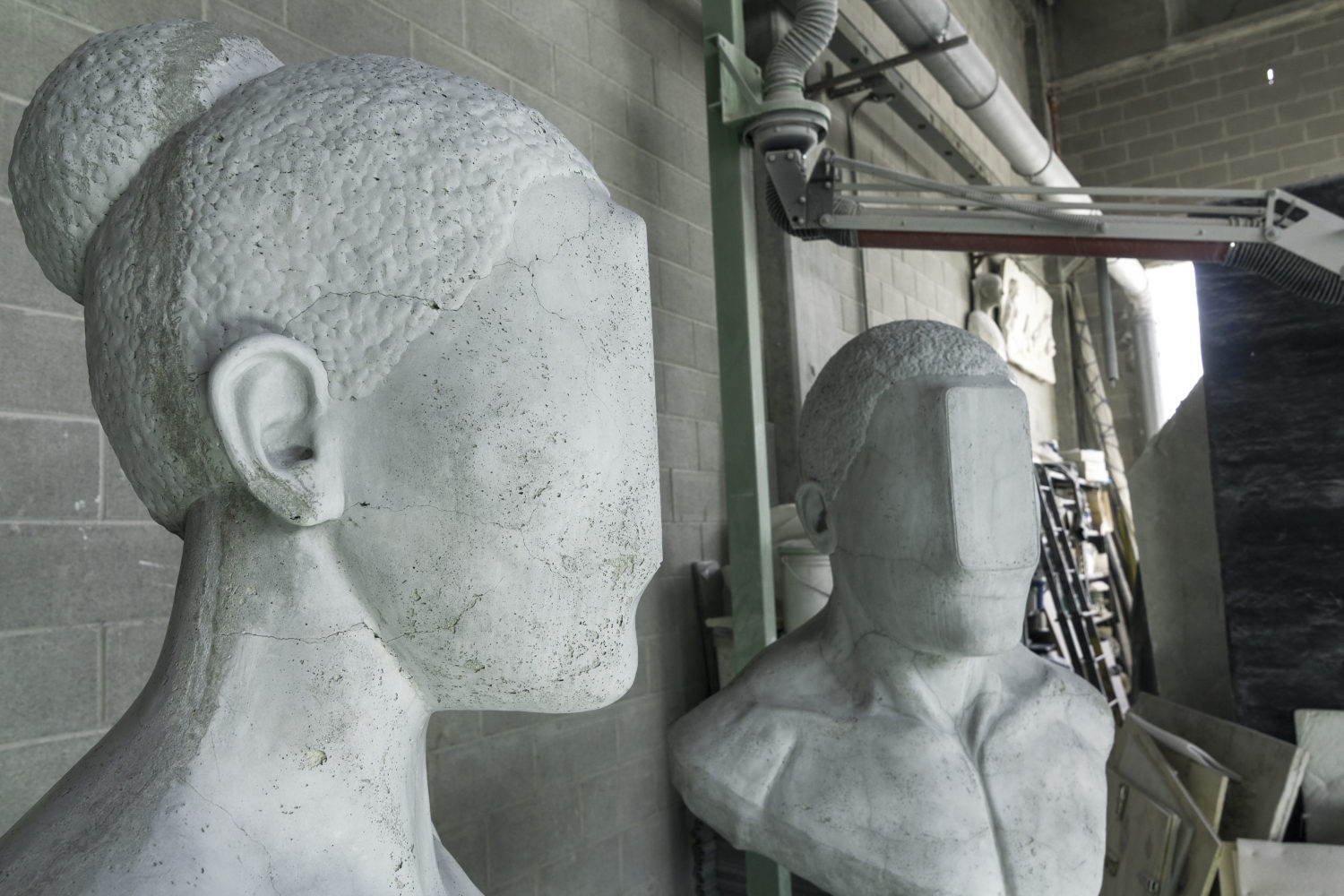
Two busts, a woman with her hair gathered in a bun and a man with close-cropped curls, rise on iron rods above rough concrete pedestals. Their shoulders end in broken, irregular edges, as if quarried rather than modelled, and the cracked grey surface evokes weathered stone. The reference to classical portrait busts is direct, but the faces have been replaced: from forehead to chin each is a flat, bevelled plane projecting forward like a visor or a screen fused with the skull. Ears, necks and collarbones remain carefully anatomical, which makes the blank front all the more abrupt. Concrete, the material of infrastructure, takes the place of marble, and the pair faces each other at a slight angle without any possibility of meeting the other's eyes.
Portrait busts were made to preserve the features of individuals a society wished to remember: emperors, philosophers, benefactors. These two preserve the opposite, a type rather than a person, and the type is defined by the device that has grown over the face. The title suggests an evolutionary step, a humanity reshaped by the interfaces it wears, in which the face, once the basis of recognition, trust and civic identity, becomes a standard surface. The couple, a man and a woman like the founding pair of a lineage, implies reproduction and continuity: the change is presented as hereditary. Placed among pipes and machinery in an industrial space, the busts look less like monuments than prototypes awaiting production.
Human perception is tuned to faces from the first days of life, and the busts frustrate that instinct completely. The eye searches for a gaze and finds a smooth slab; it expects expression and finds a surface that reflects nothing. The result is a mild vertigo, close to the unease people describe in front of someone wearing a headset, present in the room yet absent from it. The two figures are turned towards each other, a posture of intimacy, but the visors make every exchange impossible, so that closeness becomes a form of isolation. What remains readable, the delicate ear, the strained tendons of the neck, belongs to a vulnerable body that has kept listening while it has stopped seeing.
They have the bearing of ancient Romans and the faces of a gadget. Federico Clapis's New Race is a pair of life-size concrete busts, a woman and a man, each with the area from forehead to chin flattened into a single protruding panel, somewhere between a virtual reality headset and a phone screen grown into the bone. Photographed in a workshop under extraction pipes, they look like the first models off an assembly line. The question they raise is no longer science fiction: as smart glasses and headsets move from labs into everyday life, the face is becoming hardware. The busts imagine how future archaeologists might portray us.