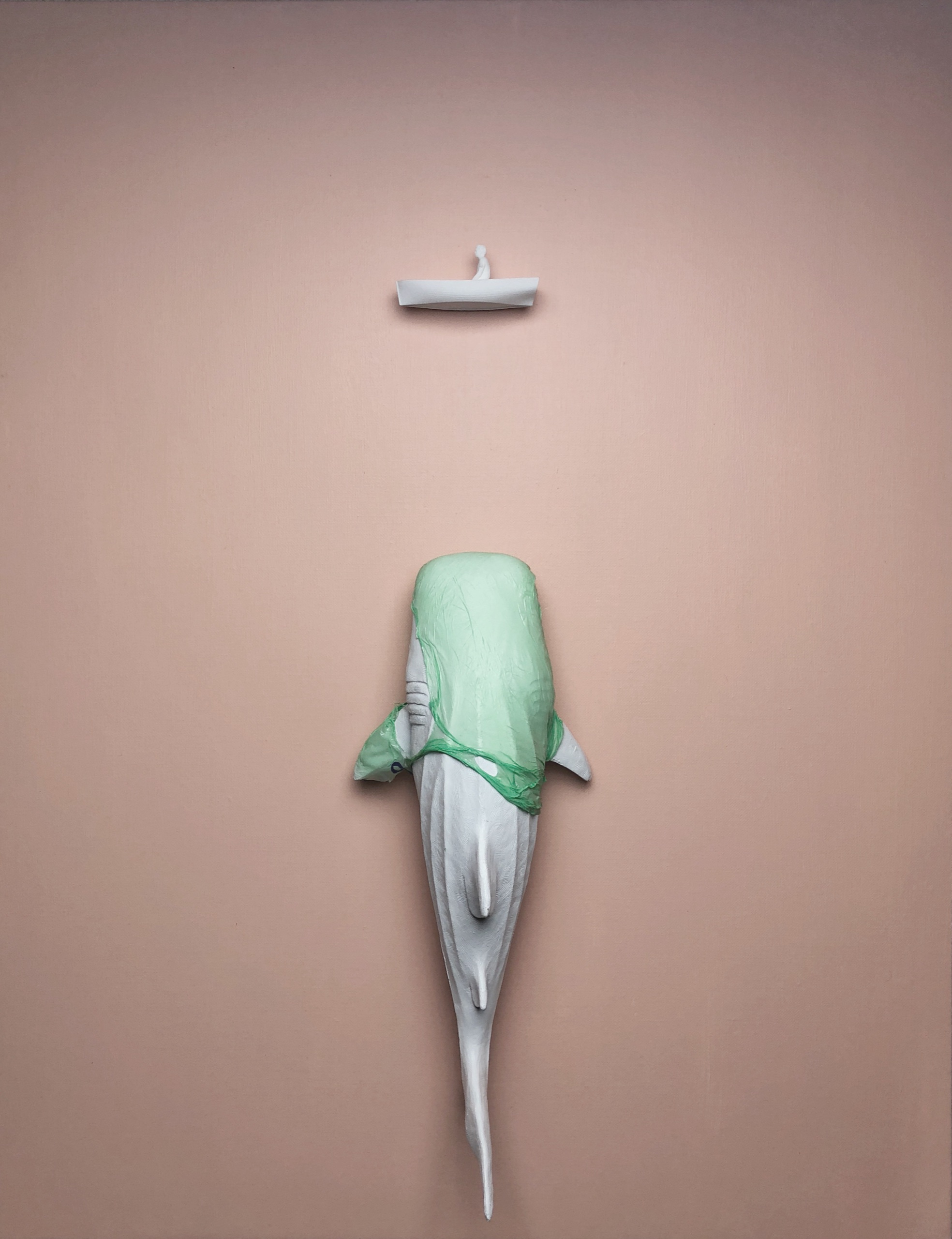
A flat, powdery pink field fills the canvas and is read, from the arrangement of its elements, as a sea seen from above. Two white reliefs in resin emerge from it. High up, a narrow boat with a single minute figure; lower down and much larger, a shark seen in plan, with fins, dorsal ridge and tail drawn out to the bottom edge. Over its head is stretched a green plastic bag, the only colour other than the ground, rendered with its creases and translucent folds. The vertical alignment of the two forms and the wide empty space between them create a silent tension. The palette, closer to a nursery or a cosmetic package than to the ocean, keeps the scene in a register of strange delicacy.
Popular culture has long cast the shark as the villain of the sea, the creature that threatens swimmers and boats. The painting turns that script around. The tiny human figure floats safely on top, while the predator is the one in danger, its head trapped in an ordinary shopping bag. The image speaks to the problem of plastic in the oceans, a consequence of daily habits so small they seem innocent: a purchase, a carrier bag, a careless disposal. Responsibility is spread across millions of gestures and therefore belongs to no one. The title can be read in both directions, as the innocence of the animal and as the self-declared innocence of the consumers whose waste reaches it.
The bag over the head is an image charged with primal fear, the fear of not being able to breathe. Seeing it on an animal produces a sharp, almost physical discomfort, and with it a reversal of feeling: the shark, usually an object of terror, now elicits pity. The work plays on how quickly empathy depends on vulnerability. The distance between the boat and the fish matters too. The small human seems unaware, absorbed in its own journey, and that obliviousness is what many viewers may recognise in themselves. The soft pink background, soothing at first, becomes uncanny, like a calm voice delivering bad news, and the stillness of the composition leaves no relief from what has been seen.
For decades the shark was cinema's favourite monster. In Innocence it is the victim. On a canvas of soft pink, a white shark in relief swims downward with a green plastic bag pulled tight over its head, while far above a tiny figure drifts in a boat, seemingly unaware. The image needs no caption to be understood, which is why it works so well: it compresses a crisis measured in millions of tonnes of plastic into a single, familiar object, the kind of bag found in any kitchen drawer. The colour scheme is pretty enough for a children's room, and that is part of the sting. Here the threat no longer comes from below the surface.