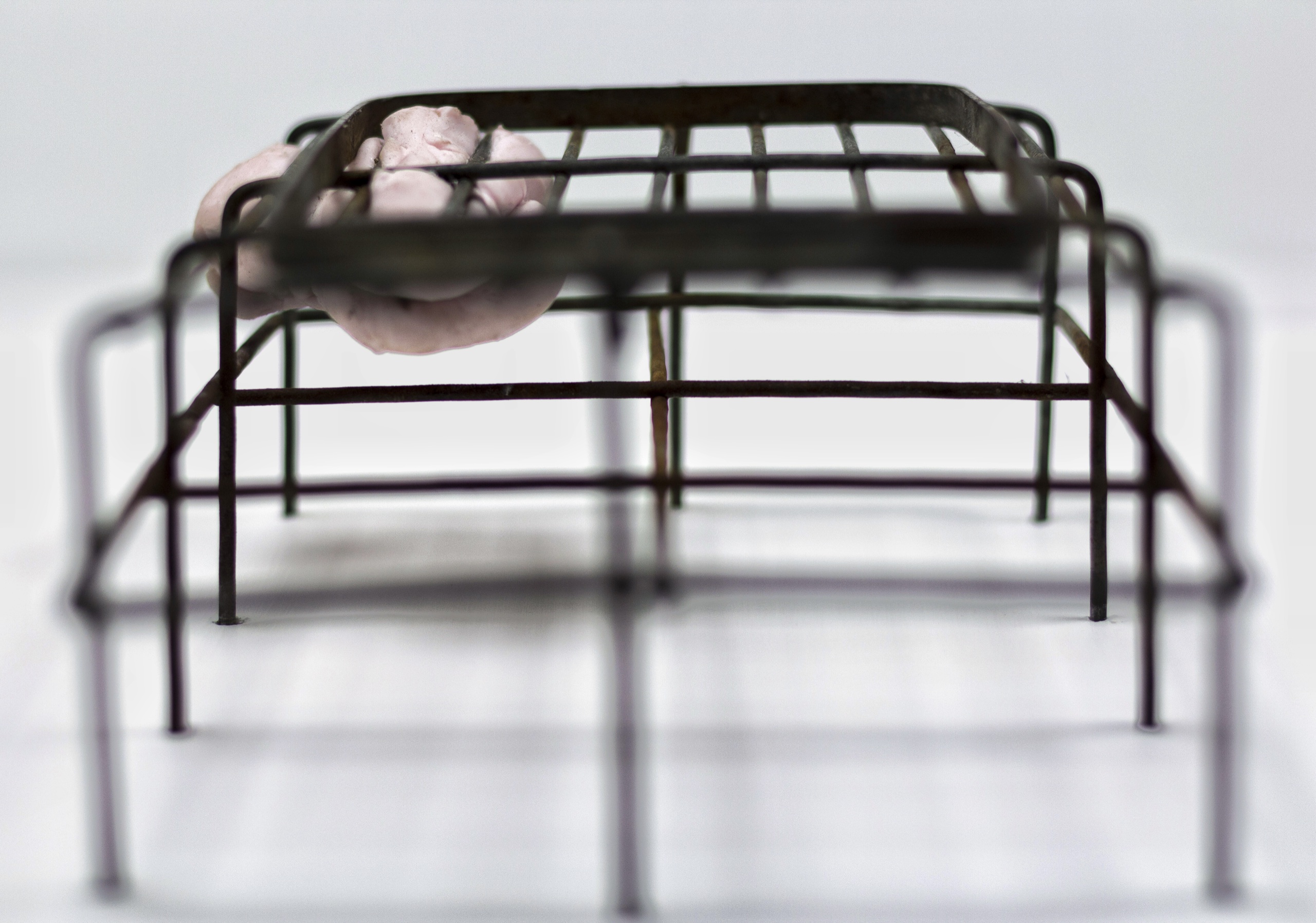
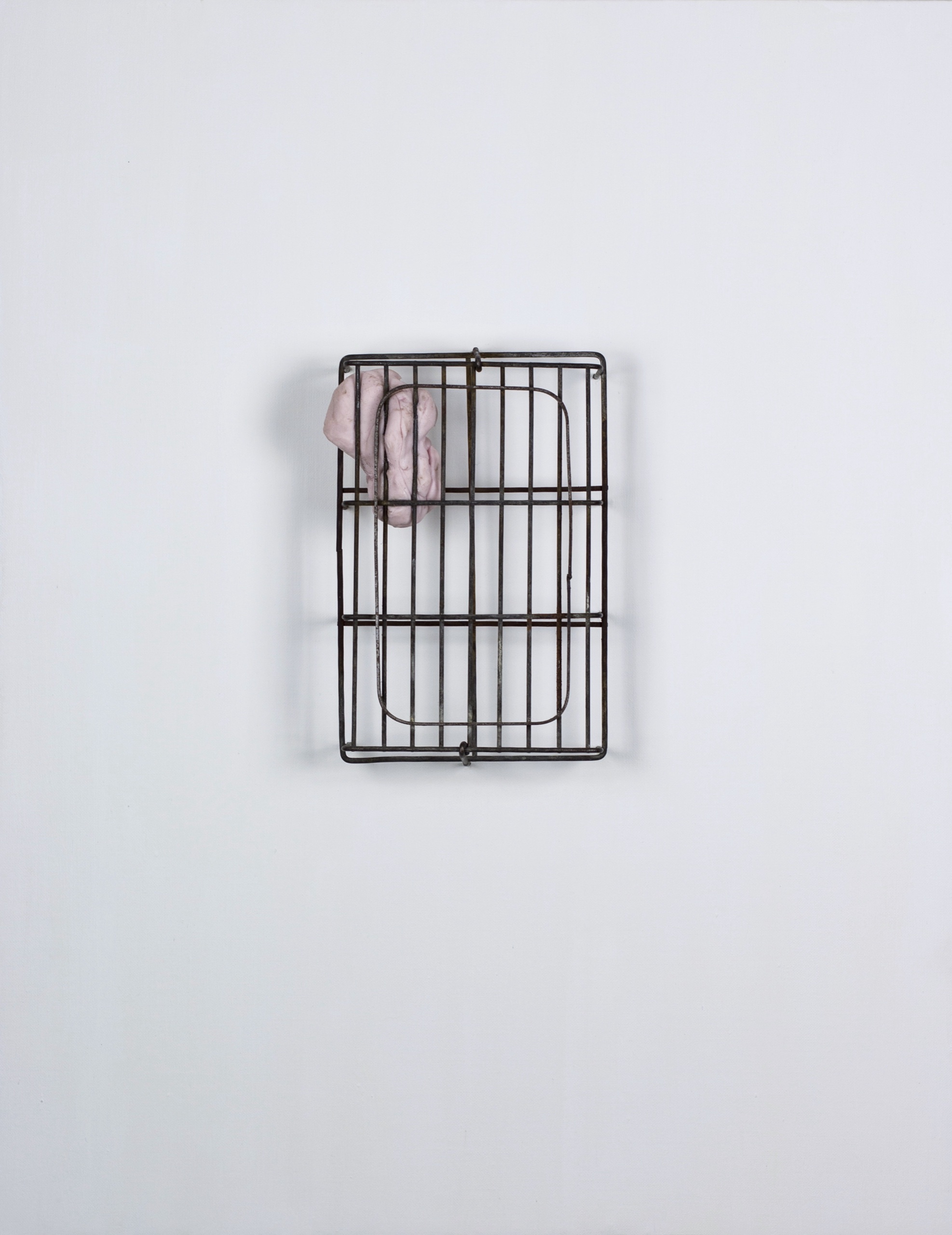
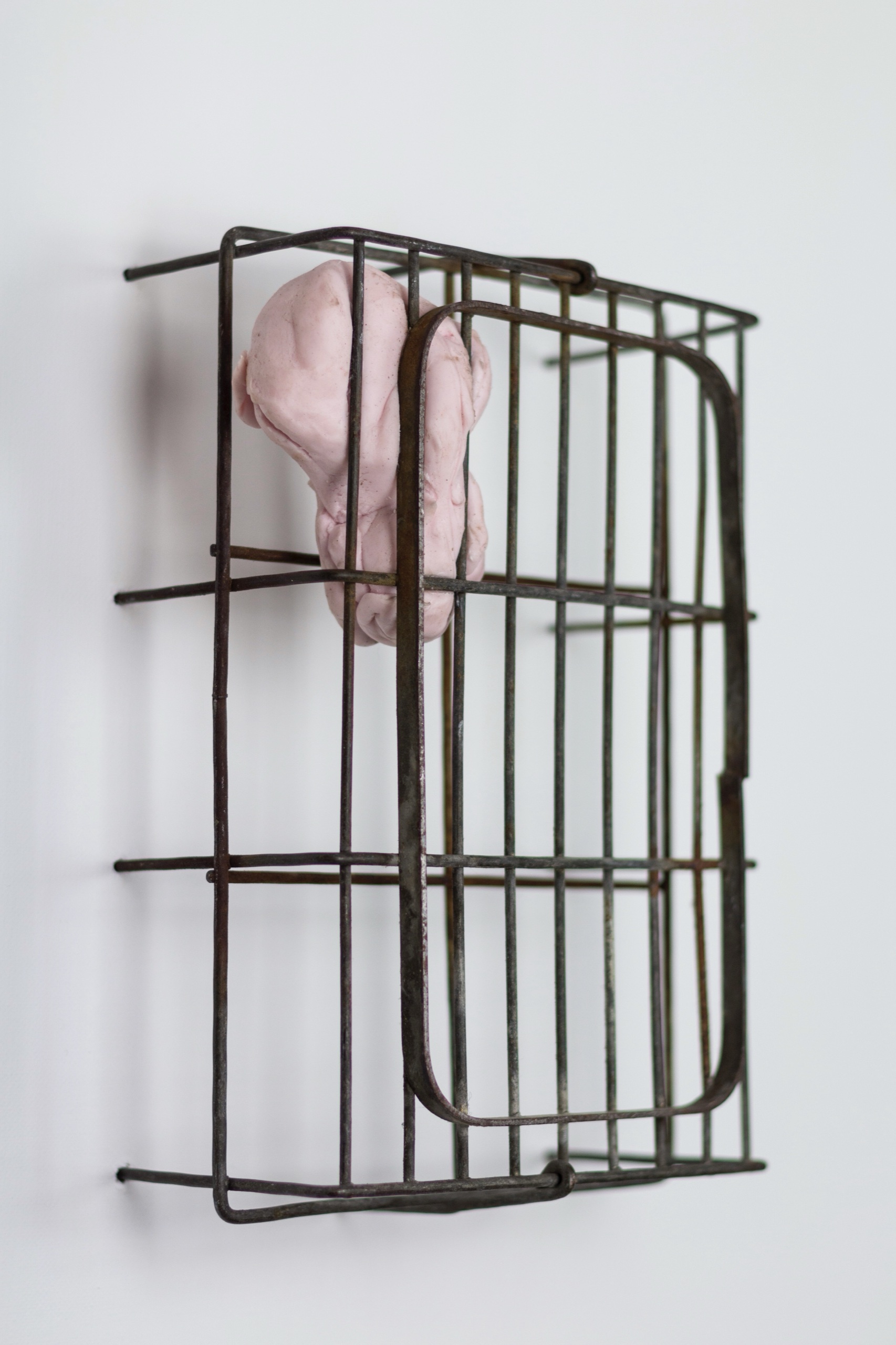
Listed among the paintings, the work behaves like a relief. Against a white ground hangs a small, dark iron grid, its thin bars joined into a cage-like rack, with a looped inner frame that recalls a handle or a lid. In the upper left corner a mass of pink resin presses through the bars, lumpy and folded, the colour of skin or of chewed gum. The grid is an old protagonist of modern art, the emblem of order and abstraction; here it is invaded by something soft and bodily that will not keep to its squares. The title carries the theological sense of spirit taking flesh, and the pink form looks precisely like matter in the act of acquiring a body.
Grids organise contemporary life: city blocks, spreadsheets, screens made of pixels, the interfaces through which people are counted and sorted. The iron structure here belongs to the same family, industrial, repetitive and indifferent. The pink mass is its opposite, irregular and singular, and it squeezes between the bars in a single corner rather than filling the whole. One interpretation sees the individual body caught in systems that were not designed around it, reshaping itself in order to pass through. Another, prompted by the title, considers how identity now takes form inside structures, platforms, institutions, bureaucracies, which provide the scaffolding on which a self is built. The flesh does not escape the grid; it lives entangled with it.
The pink form seems to be pushing, swelling against the bars as something alive does when it is confined. Whether it is entering the grid or trying to leave it remains unclear, and that uncertainty is the psychological core of the piece. Becoming a person, being incarnated, means accepting limits: a body, a family, rules, a particular place in the order of things. The rack stands for that structure, the soft mass for the drives and feelings that press against it. Viewers may feel a faint physical discomfort, the sense of tissue squeezed through metal, alongside a curious sympathy for the lump, which looks vulnerable and stubborn at once, determined to occupy its corner.
From across the room it looks like a wire rack hung on a white wall, the kind that might hold dishes or files. Up close, a lump of something pink and fleshy is squeezing through its bars, as if dough had risen past its tin or a body had been caught in a fence. The work is quiet, nearly comic, and it sticks. With so much talk of living inside systems, from algorithms to open-plan offices, Incarnation offers a blunt physical image of what that might feel like. The title reaches for theology, the word made flesh, but the scene could hardly be more ordinary, which is exactly where its unsettling charge comes from.