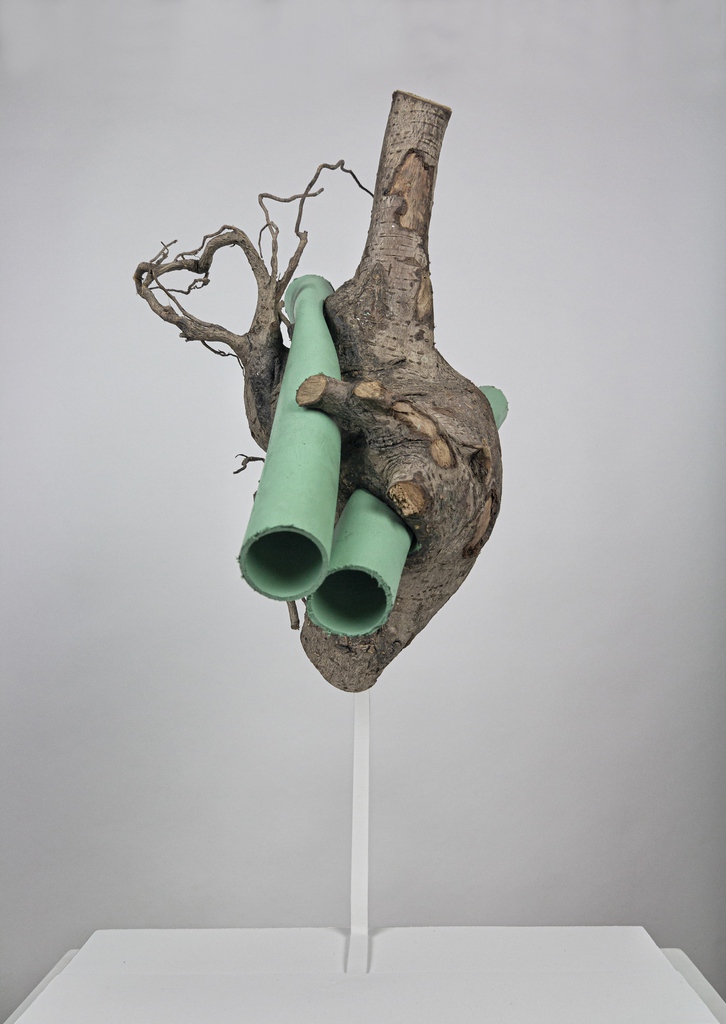
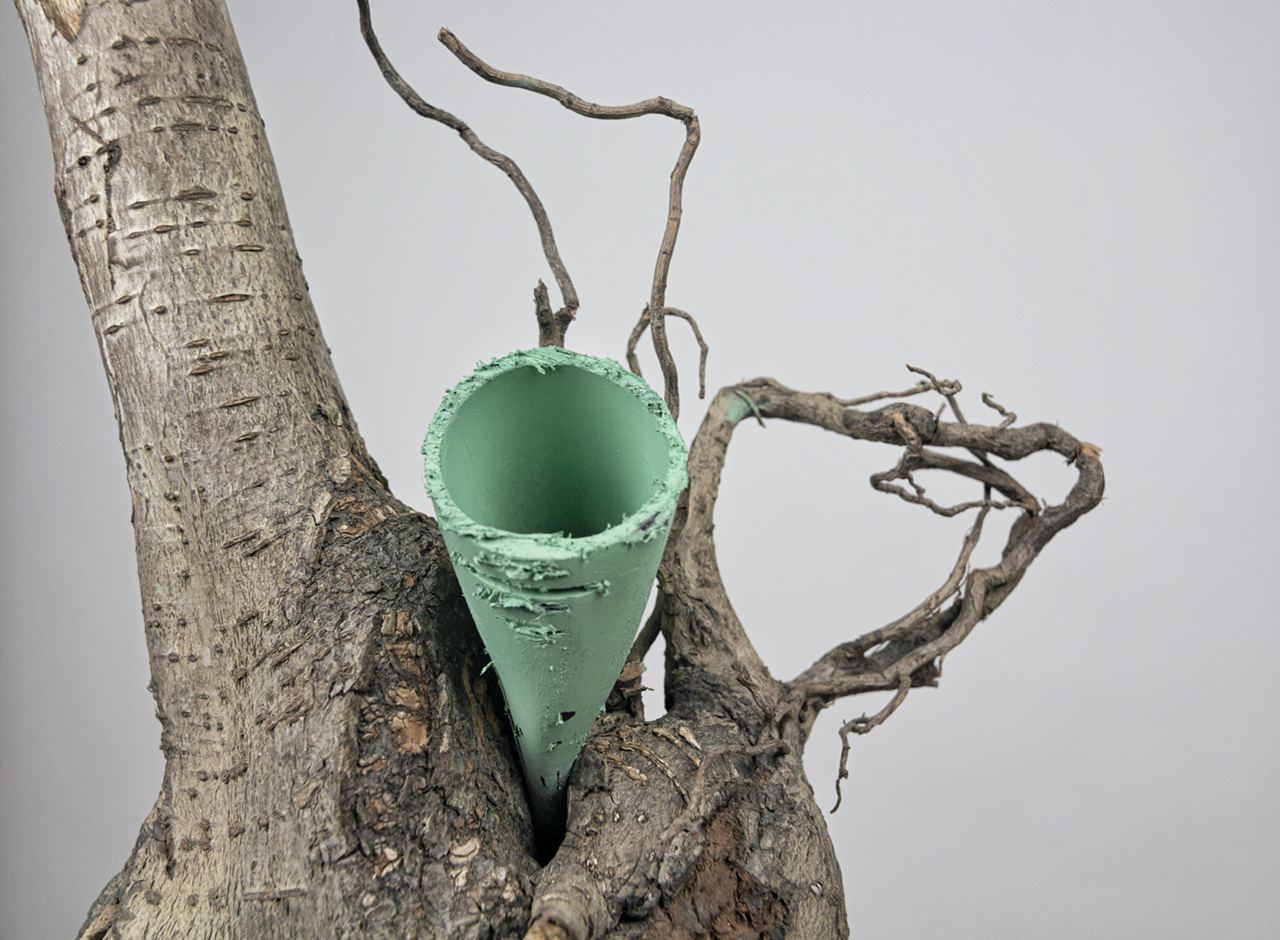
From a short length of trunk, still in its bark, the sculpture draws the familiar outline of an anatomical heart: a cut branch rises as the aorta, smaller stubs become severed vessels, and a tangle of thin, dried twigs curls at the upper left like a network of capillaries. Into this organic mass are inserted pale green tubes, raw at the edges, which read at once as plumbing and as the great veins. The palette is restrained, grey-brown bark against a mint green that recalls hospital walls and industrial fittings. Raised on a slender white rod, the object floats like a specimen in a natural history display, poised between the anatomical models of medical teaching and the tradition of found-wood assemblage.
Organic and manufactured systems are spliced together with no attempt to hide the joins. The green pipes sit in the wood like fittings in a wall, a reminder that the infrastructures sustaining contemporary life, water, energy, data, increasingly run through bodies and ecosystems alike. The title speaks of human arteries, but the heart is made of tree, implying that the circulation keeping people alive is inseparable from forests, soils and the materials extracted from them. The piece also recalls modern medicine, where stents, valves and synthetic grafts have made the repaired body ordinary. Society appears as a patchwork organism, kept going by interventions that have quietly become part of its anatomy.
The heart is the oldest emblem of feeling, and this one is not soft. Its wall is bark, scarred and cracked, and its openings are hard tubes cut roughly across. Something has been grafted in to keep the flow going. Emotionally, the image speaks of a resilience that bears the marks of damage: a heart that continues to function because it has been patched, hardened, fitted with conduits. The tangle of fine twigs at the top, fragile and nervous, contrasts with the solidity of the trunk, as if sensitivity survived only at the edges. Many viewers will recognise the experience of protecting themselves after a loss, becoming sturdier and less permeable, while some small, exposed part keeps reaching outward.
At first glance it could be a piece of driftwood picked up on a walk. Then the shape resolves: a heart, accurate in its anatomy, with a branch for an aorta and three pale green pipes plugged in where the vessels should be. Human Arteries arrives at a time when the idea of the planet as a living body has moved from poetry into climate science, and when forests are routinely called the lungs of the earth. The sculpture proposes a less comfortable version of that metaphor: an organism already fitted with industrial parts, still beating, perhaps, but on borrowed hardware. Its rough edges and torn tube rims are left in plain view, and that frankness is part of its force.