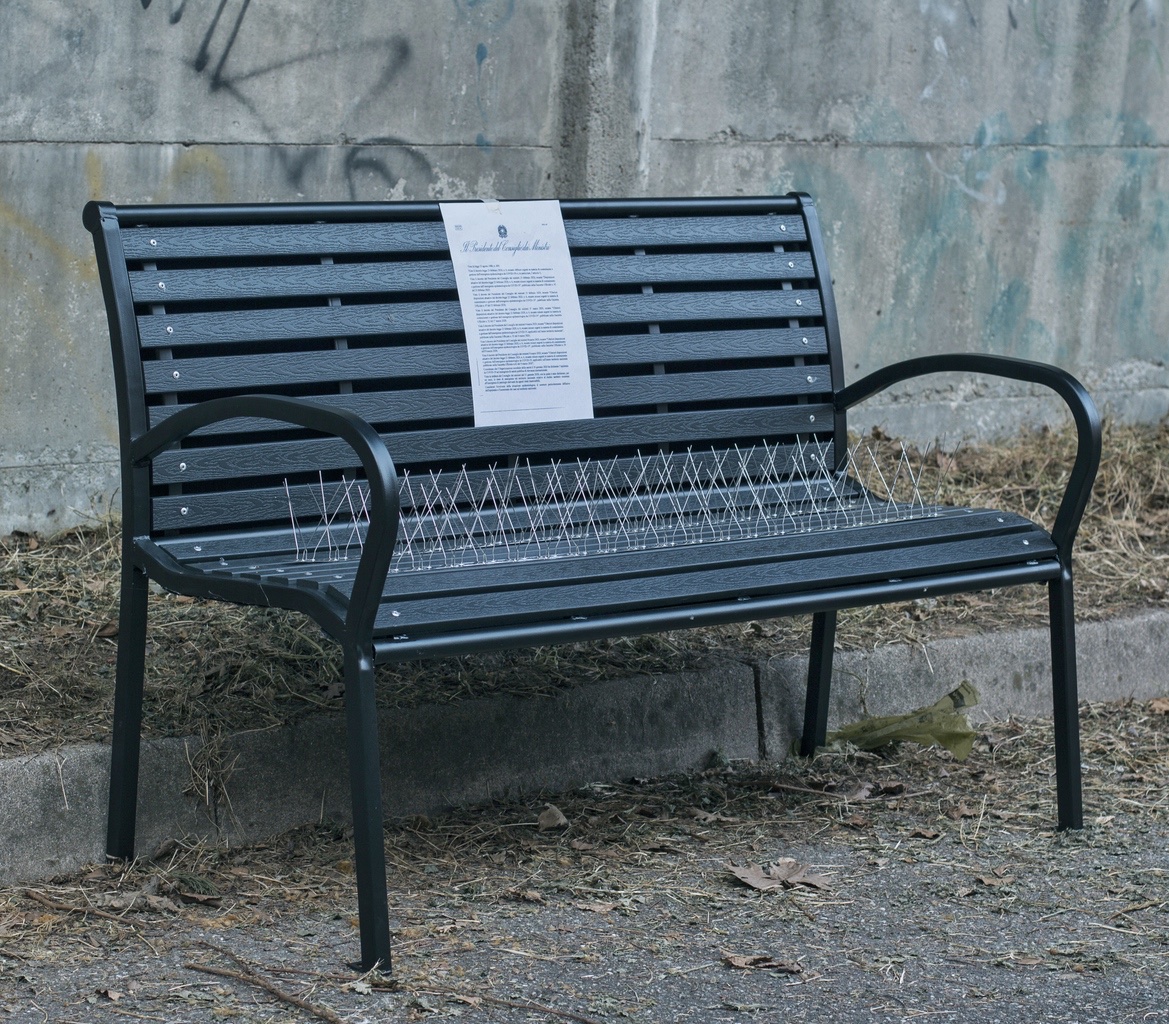
An ordinary park bench, black metal frame and grey slatted seat, stands against a stained concrete wall with traces of graffiti. Nothing about it is altered except two additions: a row of steel spikes, the kind used to keep pigeons off ledges, fixed along the back of the seat, and a printed sheet taped to the backrest, headed by an official crest and dense paragraphs of regulation. The sculpture belongs to the tradition of the assisted readymade, in which a found object is changed minimally so that its function turns against itself. Its full scale matters: at 83 by 126 centimetres it is not a model but the real thing, and it can stand in a gallery or on a pavement without changing its nature.
Urban designers have a name for spikes on ledges and armrests that divide benches: hostile architecture, built to discourage sleeping, lingering or gathering. Here the device migrates from the margins, where it usually targets the homeless or birds, onto the seat everyone uses, and it arrives with a decree attached. The year and the title point to the months when public space was emptied in the name of health, and the bench condenses that logic into one object. Care for the collective body is enforced by making shared furniture unusable. What was once an invitation to rest and conversation in the city becomes a notice of prohibition, and the boundary between protection and exclusion turns out to be very thin.
Few objects say rest as plainly as a bench. Seeing the spikes triggers an immediate bodily response, a flinch in the thighs and back, before any thought about meaning. That reflex is the work's way in: it lets the viewer feel the rule rather than read it. The printed sheet, too small to decipher from a distance, adds the familiar anxiety of an authority whose text one does not fully understand but must obey. Being told that a refusal is for one's own good produces a particular mix of compliance and resentment, and the bench holds both. It also evokes loneliness, since this is a seat built for two that now keeps everyone standing apart.
Remember the benches wrapped in tape, the playgrounds closed with chains, the notices taped to every lamppost? Federico Clapis distils that period into a single piece of street furniture: a standard municipal bench with anti-pigeon spikes screwed along its seat and an official-looking decree stuck to the backrest. The title, Health First, sounds like a slogan from the press conferences of 2020. The object feels almost reasonable, which is where the discomfort lies. Long after the emergency, cities keep installing studs, sloped seats and armrest dividers to move people along, and this bench shows how easily a temporary measure becomes the shape of public space.