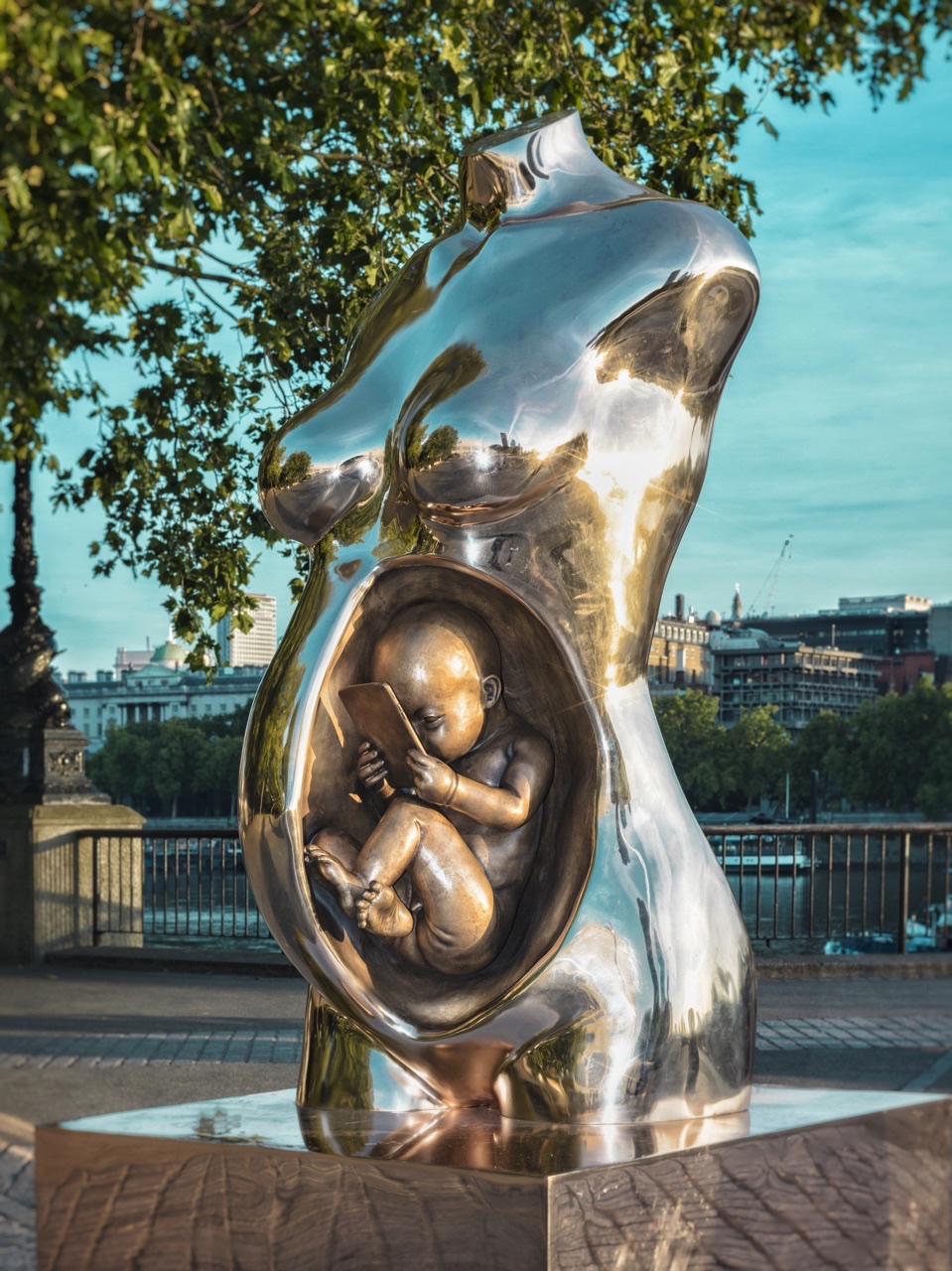
At 270 centimetres, the pregnant torso takes on the scale of a public monument, yet its subject is the most private of interiors. The headless, armless body recalls the fragmentary Venuses of classical statuary, but the bronze is polished to a mirror, so the figure absorbs trees, sky and passers-by into its skin. Into the belly an oval window has been cut, and the finish changes: inside, a warmer, softer bronze shapes a curled fetus whose hands grip a flat rectangular screen before its face. The contrast between reflective shell and opaque interior organises the whole reading. The outside returns the world to the viewer; the inside, sealed from it, is already turned towards a device. A polished cubic plinth extends the mirror downward, making the base part of the image.
Children now often meet screens before they meet words, and the sculpture pushes that chronology to its limit: the device arrives before birth. The fetus's posture is not the generic one of medical illustration but that of a user, fingers settled on the edge of a tablet, head bowed at the familiar angle of scrolling. The title ties this prenatal user to cryptography and networked value, suggesting a generation whose first environment is a connection rather than a family or a place. The mother's body, without head or arms, becomes an enclosure, a housing for a relationship that bypasses her. What emerges is a question about who, in the economy of attention, claims a person first, and how early that claim begins.
Pregnancy is usually imagined as the first and most complete bond, the moment when a child's world coincides with another body. The fetus in this bronze has turned away from that world: its eyes are lowered to the screen, not to the inner wall that holds it. The image touches a deep anxiety of parenthood, the fear of being bypassed, of providing the shelter while something else provides the attention. It also touches the viewer's own habits. Standing before the polished belly, one sees one's reflection wrapped around the opening, so that looking at the child means watching oneself look. Calm, almost serene, the curled body suggests that the absorption is not experienced as loss, which is perhaps the most unsettling part.
Long before a first word, a first step or a first tooth, the baby in this bronze already has a screen. Set on a mirror-bright plinth, the giant pregnant torso stops passers-by twice: first with its gleam, which turns trees and buildings into liquid reflections, then with the window in its belly, where a curled fetus is absorbed in a tablet. The joke lands quickly; the unease lasts longer. Parents argue about screen time for toddlers, schools debate phone bans, and lawmakers ask how young is too young for an online account. Crypto Connection skips the debate and imagines its endpoint, a human being whose umbilical cord, so to speak, already runs to the network.