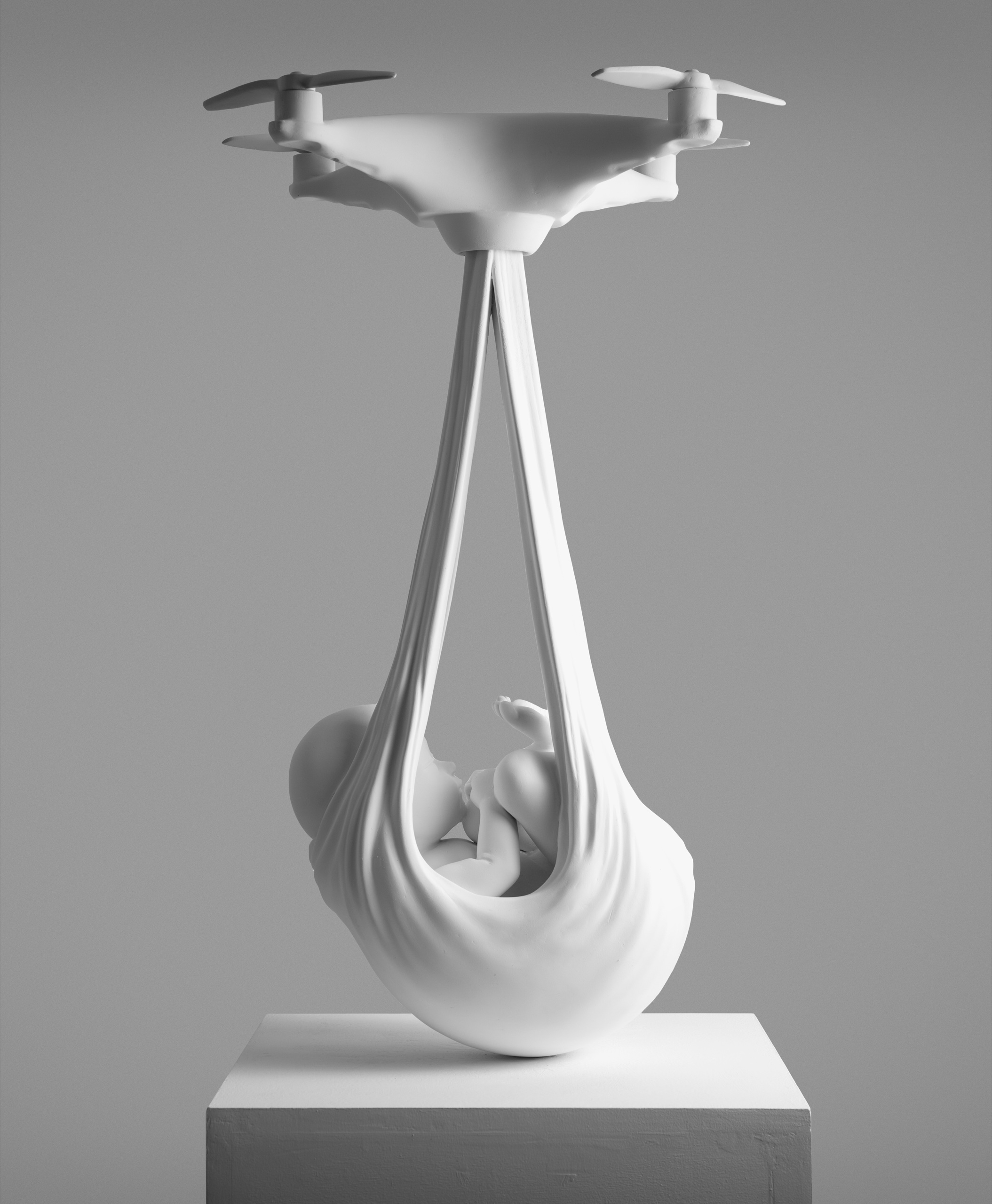
The composition reads from top to bottom like a vertical diagram: four rotors, the flat body of a drone, two long bands of cloth, and at their lowest point a sleeping infant gathered in a sling. Everything is cast in the same matte white resin, so machine, fabric and flesh share one skin and one light. The drapery is handled with a sculptor's attention to classical folds, pulled taut where it bears weight and slack where it wraps the child's back. The image borrows from the folk iconography of the stork that carries a newborn in a bundle hanging from its beak, replacing the bird with a consumer quadcopter. At the base the swaddled form just grazes the plinth, a delivery caught at the instant of arrival.
Home delivery has become the defining service of the platform economy, and drones are its promised next stage: parcels lowered from the sky, without courier or doorstep conversation. The sculpture applies that logistics to the most significant arrival in any family. The stork of children's stories was already a way of keeping the facts of birth at a distance; the drone updates the euphemism for a time of assisted reproduction, surrogacy and online ordering. What disappears is the human chain of parents, midwives and community that has always surrounded a birth. The child arrives as a shipment, and the work measures how far convenience and automation can be extended before they reach territory that has always been relational.
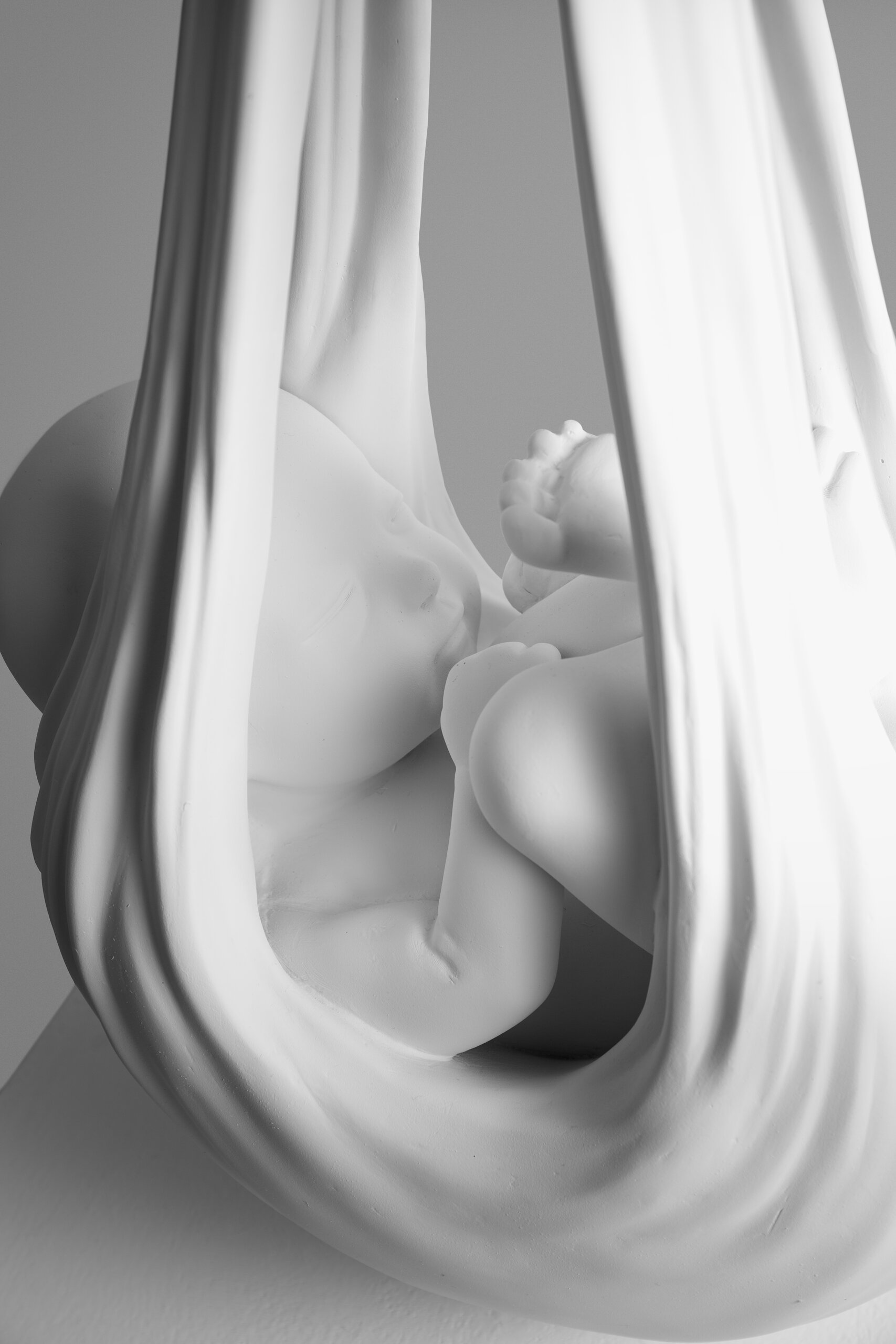
Nothing in the infant suggests alarm. Eyes closed, thumb in mouth, knees drawn up, the baby shows the classic self-soothing posture of a newborn, a body that comforts itself because no other body is holding it. The sling replicates the shape of arms or of a womb, but it hangs from rotors, not from a person. Attachment theory places the first relationship at the root of later security; here the first carrier is a machine that hovers and does not hold. For the viewer the effect is double: the softness of the sleeping child calls up tenderness, while the propellers above, motionless yet implying noise and wind, keep that tenderness on edge. The calm is real, and precarious.
Forget the stork. In this white resin sculpture the newborn comes by drone, swinging beneath four propellers in a cloth sling, thumb in mouth and fast asleep. It is a sly image, half nursery mobile and half product demo, and it lands squarely on the conversations of the moment: delivery robots on city pavements, apps that promise to handle every chore, the growing automation of care itself, from cribs that rock on their own to monitors that analyse a baby's sleep. Babydrone keeps its humour light, which is what makes it effective. The baby looks perfectly content. What the piece leaves hanging, quite literally, is who will be there to receive the delivery.