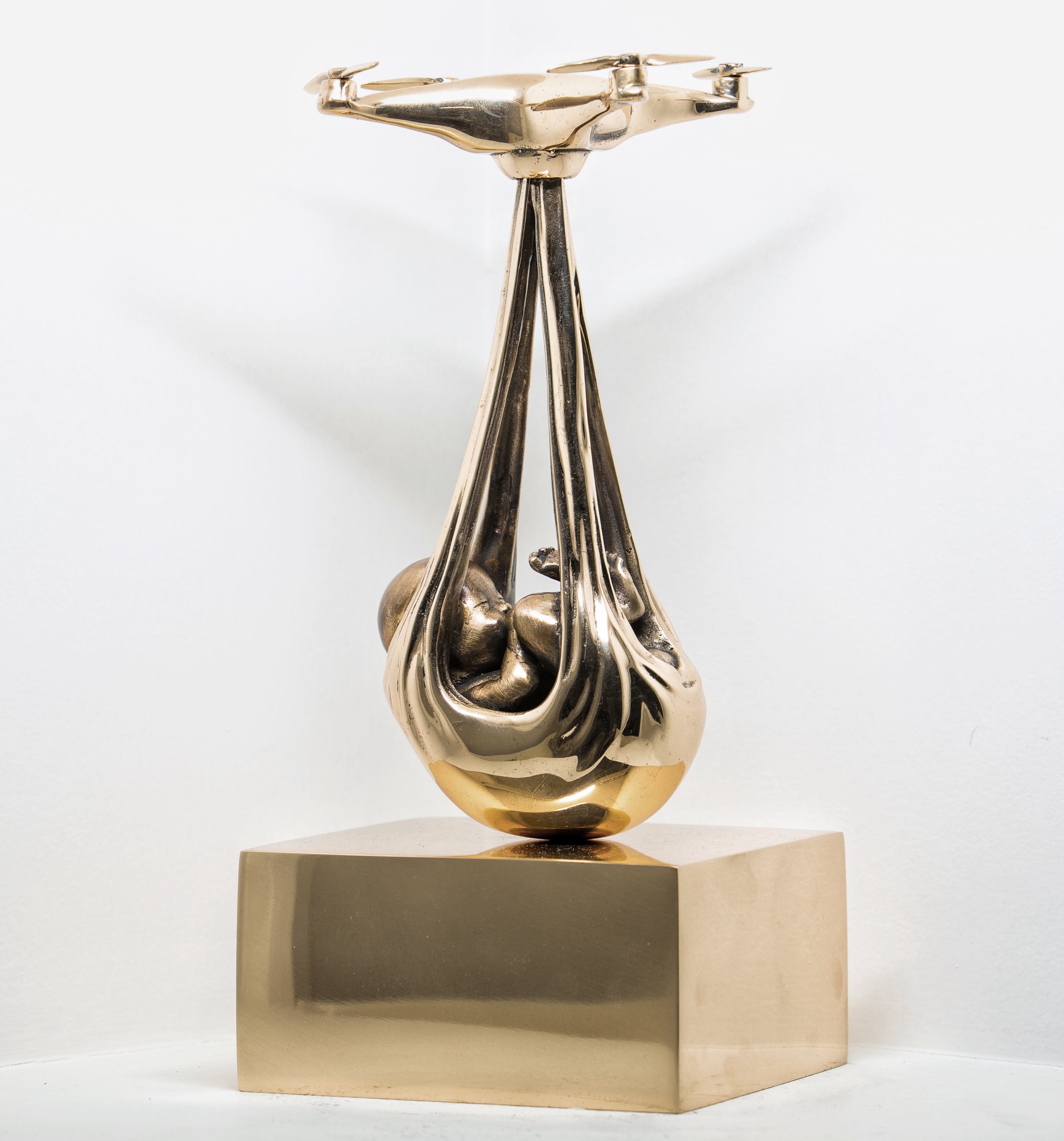
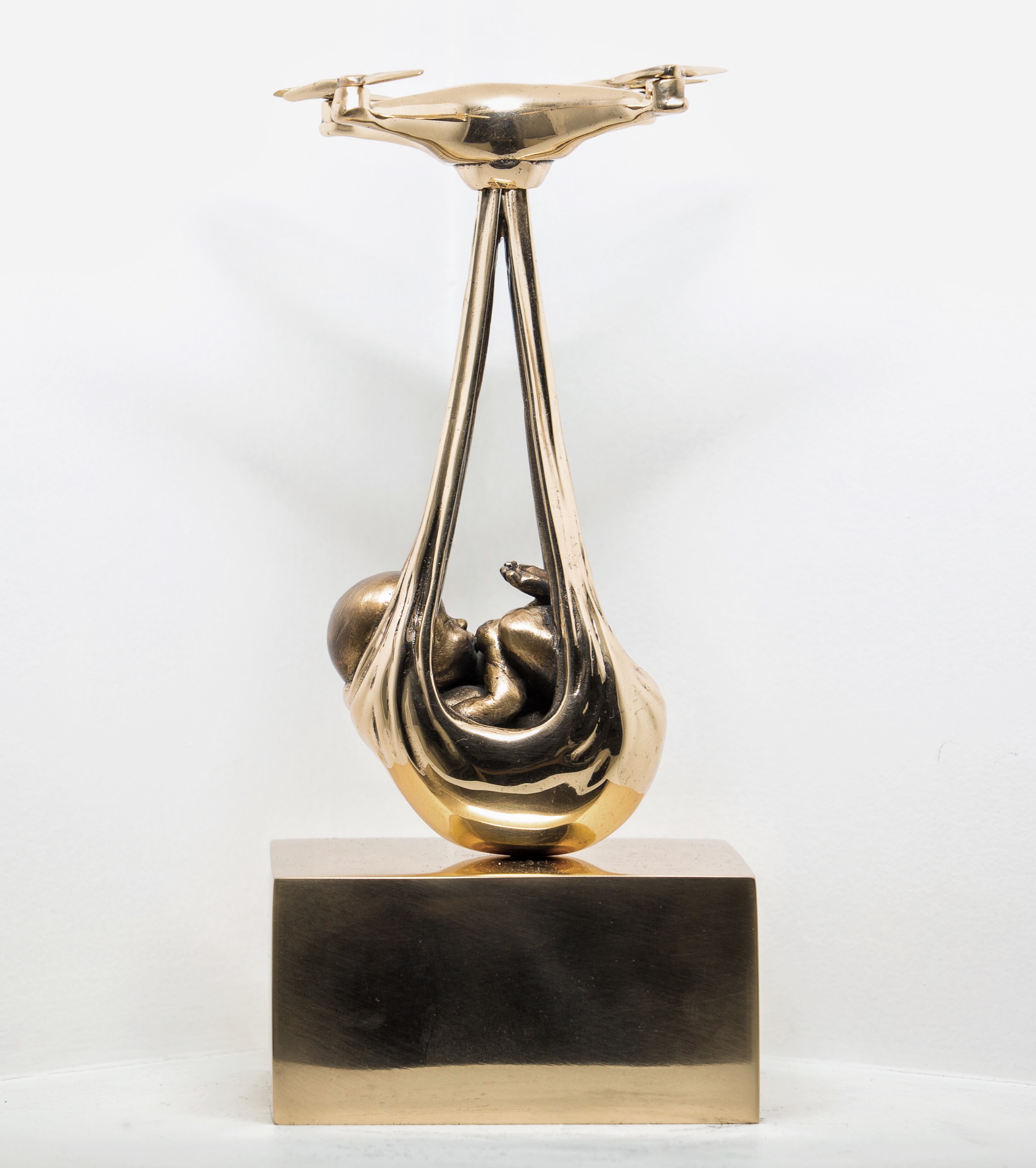
A quadcopter, its four rotors rendered with jeweller's precision, hovers above a gleaming cube. From its underside a long fold of cloth descends and gathers into a sling, where a sleeping infant lies curled with one small hand raised. The whole is cast in highly polished bronze, so that machine, fabric and flesh share the same golden skin and the same reflections. The composition is a vertical drop, a pendulum held in suspension, and it updates one of the most popular images of Western folk iconography, the stork carrying a newborn in a bundle from its beak. At only 32 cm high, the piece has the intimacy of a devotional object or a christening gift, while the plinth lends it the authority of a trophy.
The old fable told children that babies were delivered from the sky. The work brings that fable up to date in the language of logistics, where drones are tested to deliver parcels, medicines and meals. The joke carries a real question about how births are increasingly mediated by technology, from fertility treatments to monitored pregnancies and the online purchase of everything a newborn needs. It also touches the way parenting is outsourced to devices: baby monitors, apps that track sleep, screens that soothe. Casting the scene in precious metal recalls the ceremonial gifts that mark a birth in many families, but here the gift seems to come from the platform rather than the community. The child is valuable, wrapped, and shipped.
Everything in the infant's posture speaks of trust. The body is folded as in the womb, the face turned inwards, the tiny fist relaxed; the baby sleeps because it feels held. What holds it, however, is a machine with no arms and no warmth, only lift. This is where the work touches early attachment. The first bond is built through touch, rocking and voice, and the sculpture asks the viewer to imagine that experience entrusted to propellers. Many will feel a reflexive tenderness followed by unease, the protective urge to catch the sling should it slip. The shine of the bronze makes the scene seductive, a reminder that convenience often presents itself as care.
The stork has been made redundant. In Babydrone, a sleeping newborn swings beneath a four-rotor drone, swaddled in a sling of polished bronze that gleams like a family heirloom. It is a funny image, the sort that gets shared at once, and then it lingers. Delivery drones are no longer science fiction, and new parents already surround cribs with cameras, sensors and apps; the step from receiving a package to receiving a person feels shorter than it should. The sculpture is small, just over thirty centimetres, and that scale keeps it intimate, more keepsake than warning. It gently raises one question for the age of automated everything: who exactly is doing the carrying.