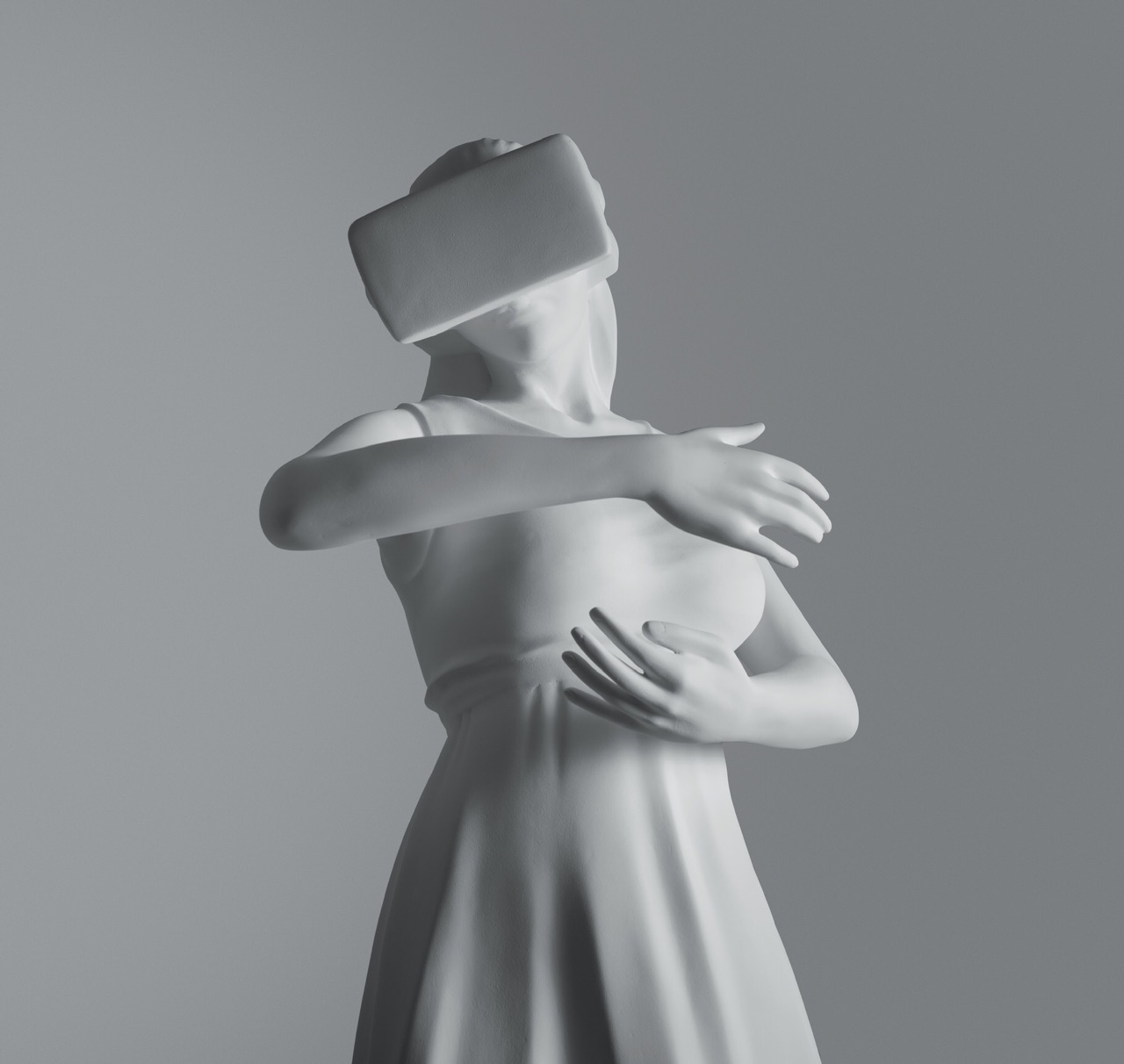
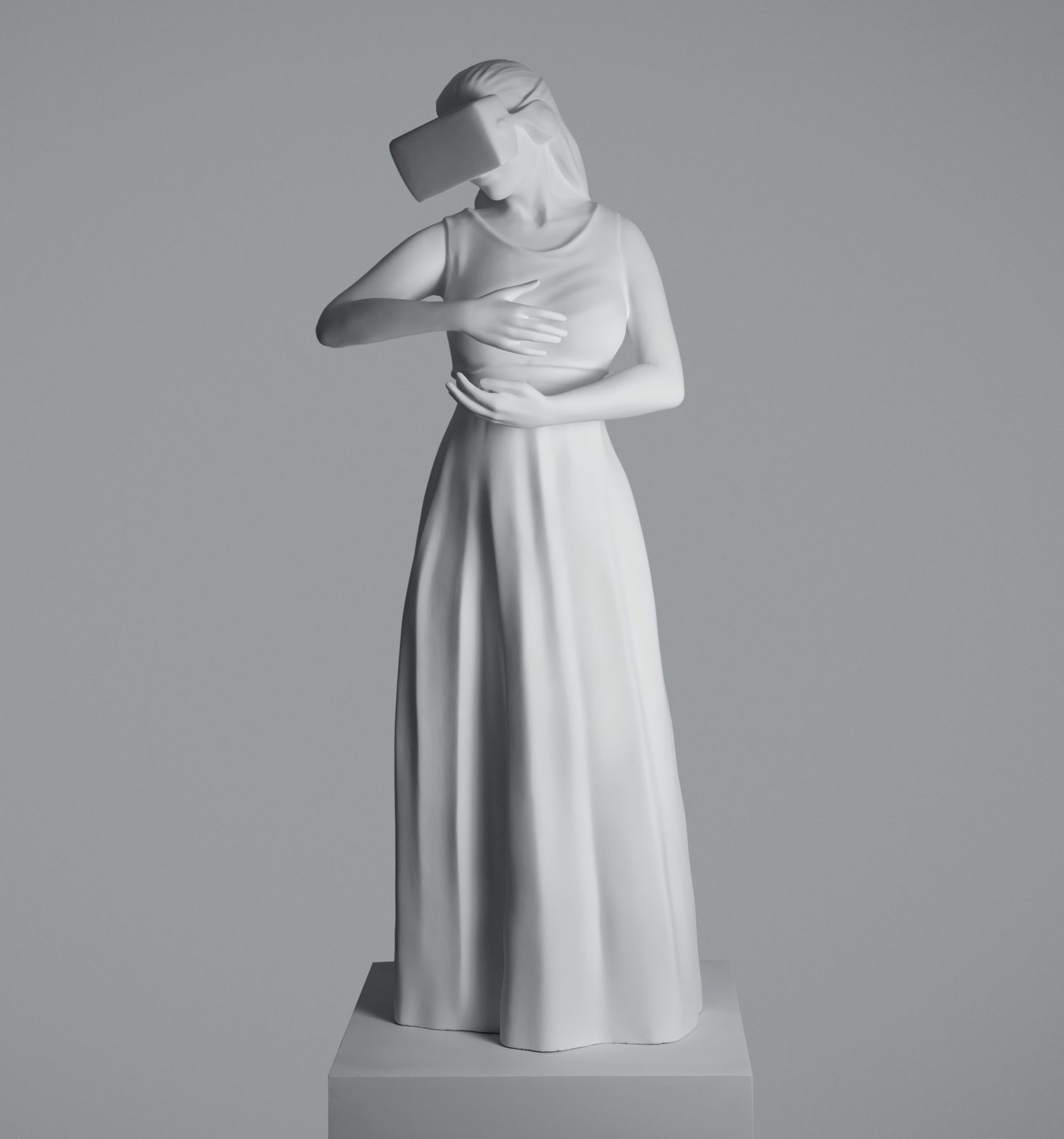
The title fuses two Marian names, the Addolorata, Our Lady of Sorrows, and the Immaculate Conception, and the figure answers to both. In matte white resin, close to human height, a young woman in a long sleeveless dress inclines her head with the tenderness of a Madonna; her arms form the classic cradle of a mother holding an infant to the breast. The arms, however, hold air. Over her eyes sits a virtual reality headset, rendered as a smooth, heavy block, the only geometric form in a body of soft folds and falling hair. The monochrome surface, close to plaster or marble, sets the device on the same plane as the drapery, as if it had always belonged to devotional iconography.
Motherhood has always been shaped by its technologies, from the wet nurse to the baby monitor, and the figure imagines a further step: maternity performed inside a simulation. She stands in the posture of nursing, yet the child exists only in the headset. A first reading points to a society where experiences once rooted in the body, care, intimacy, even reproduction, are offered as immersive content. A second concerns delayed or impossible parenthood, a widespread condition in ageing societies, which a virtual world might promise to console. Either way the work registers a shift in how desire is managed: not satisfied, but rendered. The plain dress, without any marker of class or era, lets the woman stand for many.
The empty embrace carries the emotional weight. Her fingers are curved with precision, the lower hand palm up to support a weight, the upper one spread as if to steady a small back: the muscle memory of a body that expects a child. 'Grieving' in the title speaks of loss, and the headset becomes an instrument of mourning, a place where an absent child can still be held. Psychology knows this tension between comfort and avoidance: a substitute that soothes can also keep pain from being worked through. Viewers may feel tenderness and discomfort at once, as if they had walked in on a private ritual. Her bowed head, eyes hidden, keeps the experience wholly interior and leaves us outside it.
Put on a headset and you can climb mountains, attend concerts, walk on the moon. The young woman in this white resin figure appears to be doing something stranger: holding a baby that is not there. Her arms are set in the gentle angle every parent knows, her head bent towards the missing child, her eyes sealed behind a blocky visor. Virtual reality is sold as escape and entertainment, but its uses are quietly widening, from therapy to digital recreations of people who have died. Addolorata Concezione meets that frontier with the vocabulary of a church statue, and the collision is hard to shake: devotion, grief and consumer electronics sharing one smooth white surface.